Why We Read: 2

Being a project dedicated to growing Colorado literature, we ask ourselves this question at the Almagre quite a bit. Why build a journal, paper no less, and expect others to read it?

For us, the easy answer is this: pick up a copy of Issue 3, open it, fan the pages, breathe in the spine’s scent. Take it, sit with it, create a silent space. Then…explore the poems within, the stories, the essays, the art. We know that the Authors and Artists in Issue 3 will give any reader their money back many times over…restored in full with ideas, new perspectives, as-yet-learned words, and renewed optimism in the power of imagination.

But that is self-serving. And it’s really about more than our journal. It’s about participation in all that’s going on. Literature promises truth; and that is even when it distorts history, or kneads it, bends it, warps it, or is about hypocrites and thieves and liars; or deals with gouging, skullduggery, banditry, or lowlifes. Literature promises truth, because it triangulates around it, shines a flashlight one way, then another, producing a changing shadow that can provide deeper understanding. The point is, literature begs us to know that any given subject requires curiosity and examination from multiple angles. This curiosity should never end.

We’ve entered an age of alternative facts…and that is a worrying thing. In certain venues, we prefer it one way—facts as facts—a thing which doesn’t build on alternatives but on additions. With literature (fiction and nonfiction), we are faced with an honest proposition: “Here is my side of the story,” or, “Here is a side of the story.” By taking the time to do this, we acknowledge that a gain in understanding is a journey. A matter of course. For those who believe they have reached a destination, we feel pity.

To read is to fend ignorance, acquire knowledge and wisdom, to join the polity as those who would prevent a world of alternative facts. For many of us, it is the way forward.

With Profound Gratitude to all our Readers,

Editor & Artist, John Lewis


Publisher, Joe Barrera, shares about John Nichols

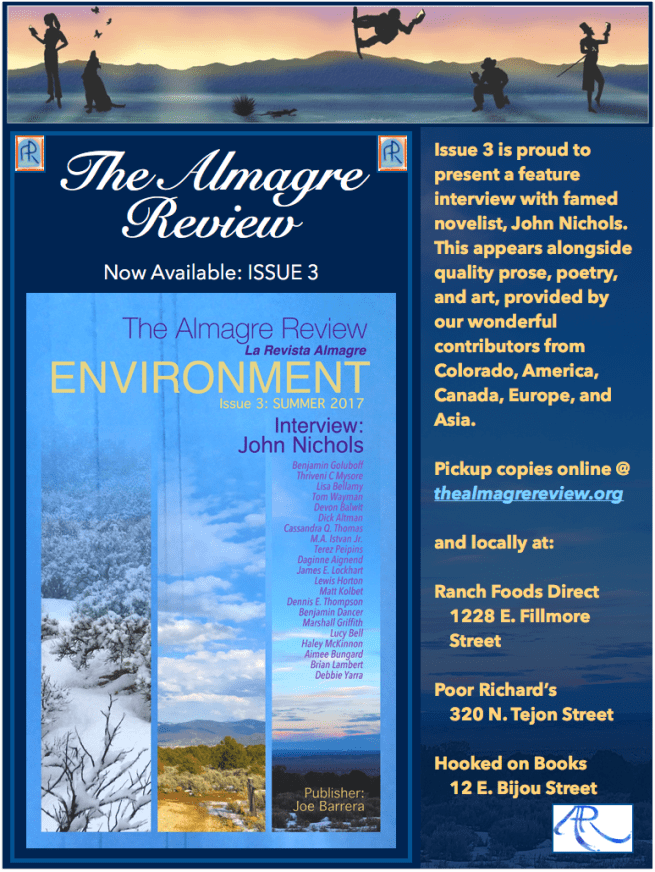
Issue 3 of The Almagre Review–Environment–features an interview with Taos writer John Nichols.

We are fortunate to have with us a writer and philosopher whose name everyone knows.

John T. Nichols, best known for his Milagro Beanfield War Trilogy, lives in Taos, a mere 4-hour drive from Colorado Springs. He has written numerous novels, whose setting is usually the hardscrabble Chicano villages of northern New Mexico. John Nichols captures the ambiance and the culture of the people of northern New Mexico like no other writer, whether Anglo or Hispanic. If for no other reason, this would set him apart as an American writer of the first-class–one who is faithful and accurate in rendering his subject matter–and in the process revealing to the world a much ignored people who deserve to be recognized.

John T. Nichols is also a prophet, warning us of the fragility of our planet. He is a lover of nature, happiest when he is climbing the peaks of the Sangre de Cristo and fishing in the Big River, el Rio Grande. HIs latest environmental book, the last in a long list of books dealing with nature, is called My Heart Belongs to Nature. Read it. You will be moved at the lyricism of his descriptions and the beauty of his photographs.

Joe Barrera, publisher
The Almagre Review
June 18, 2017

Issue 3 is Here!

To all the artists who whittle flakes from their core and put it into paper; The Almagre Review wishes to say thank you. To all our readers…Issue 3, ENVIRONMENT, is here. Come support, read, and delight in those who shape narrative and tell our story. Their essence can be found in these pages.

Issue 3: ENVIRONMENT, available June 22

In January, 2017, The Almagre Review went to Taos to interview famed American author John Nichols. For two nights, he spoke about his life, his novels, and his political and environmental philosophies. Highlights from this interview are in Issue 3: ENVIRONMENT.

A literary journal founded in the crease; Come be a part of the narrative that tells the story of the mountains and the prairies.

Book Chat: The GAIAD

On the brink of The Almagre Review’s publication of Issue 3 Environment, this is a perfect time to reflect on our Issue 2 contributor, Will Burcher, and his recent book, The GAIAD.

Mr. Burcher’s novel surprises! It also makes big promises. The author possesses an intelligent, cunning, almost slickly in-between, ability for prose and idea. The idea—well, it is large. How large? Immense. And the prose—it combines grit and realism with an unapologetic use of literary language. I confess to learning new words in this book (for me, a pleasure).

The protagonist, Fleur Romano, a competent twenty-something-year-old Denver cop, is in obvious need of a big adventure. Don’t we all? Something of a loner, she manages to get to a concert, sans friend or partner or date. This is where it begins. The adventure! And the author kickstarts it with a mysterioso of haze, trance music, performance art, and a shock-pool of blood.

We’re soon thrusted into a pan-historical epic that is an international-action-thriller/illuminati-esque/spiritually-ecstatic tale delivered in Mr. Burcher’s competent handling of prose. For instance, when the heroine, Fleur, is shown a video by her abductors, the reader is made to feel as if the video is actually being watched. Not an easy task.

As the narrative peels into the driving premise of the novel, the story surges through time, back into the deep past where humanity is shattered. What kind of story takes 30,000 years to tell? Why do stone-age animal hunts and cave paintings figure into the book? How does this necessitate the appearance of elegantly thin spaceships calibrated to a cosmic music? Did I mention that Mr. Burcher makes big promises? The answer lies hidden in the title.

The GAIAD, the first installment in the Logos series, lives up to that promise. Perhaps as interesting a question as this grand adventure is, is whether the author can deliver the goods in the following books. This story is a joy to discover, and I fell completely in line with Mr. Burcher’s narrative voice. We luxuriate in the sensuousness of the language—in many ways, this is a story of the flesh. Not vulgarly. But the grand secret that drives it all, begs the author and the audience to experience this tale as one expressed deeply inside the skin.

There are many things the author has done well in his telling. The close proximity of high and low, grit and eloquence, provide a constant strength to the text. This is Mr. Burcher’s debut novel, and as a Coloradoan, we are lucky to have him. I feel optimistic that the following books will carry this epic tale to its right and thrilling conclusion.

For those interested, please support local art, local artists, and visit Will Burcher’s site @ https://williamburcher.com/# to find your way to a copy.

John Lewis

Issue 3, Environment; An Exciting Edition on its Way

Here at the Almagre, we are thrilled about our upcoming issue (Publication in JUNE). This will be a great opportunity for Colorado readers and writers to experience fantastic local talent alongside voices from all over (and we do mean all over!). There is, of course, the interview with famed Southwest writer, John Nichols, sharing insight about his environmental philosophy and the ways it manifests in his writing.

But this issue will feature much, much more. Readers will find contributors from all over the country whose work has appeared in other prestigious publications such as the Massachusetts Review, TriQuarterly, Asimov’s Science Fiction, The Sun, and others. We have words penned by some of Colorado Springs’ finest talent as well as beautiful poems from as far away as India and the Netherlands.

These are exciting times for Colorado Springs’ newest literary journal, and we’re asking those who are passionate about art and narrative to come join us. Spread the word to friends, to family, to fellow authors and artists. Absolutely everything we make from this passion-project pours back into the pages which carry the magic of the written word. Come help us tell the story of America.

          With Gratitude,
          The Staff of La Revista Almagre


Contemporary Heroes; Hooked On Books

Yes, in the spirit of leadership, the theme of issue two, we’d like to honor bookstores and especially their proprietors.

The Almagre Review wants to take a minute to thank Hooked On Books for their enduring dedication to Colorado Springs’s local authors. One might not realize this, but Jim and Mary Ciletti devote a tremendous amount of time and resource to writers who publish and sell their work locally.

The bookstore, we all know, is a diminished institution. This is not because we read less than we used to; that is a misconception. We read more than ever. But, we read differently. Deep attention to long, rich works grows scarcer by the year. We collect information like grains of sand blowing through the air. News by captions! This is the age of trying to form complex world-views out of a chaotic constellation of information. Our contemporary consumption of the written word has conferred all its disadvantages upon the local bookstore.

Companies like Barnes and Noble can manage, but even then, not all the large companies survive–Borders went out of business. And for the mom and pops bookstore? To find one is a treasure, to support them–a public service. There’s a touch of the heroic, born of faithful dedication, to Jim and Mary Ciletti for their labors in sustaining a brick and mortar location for story enthusiasts like us.

As a gesture of friendship, take the time to stop by Hooked On Books, or any bookstore. The Almagre recommends this from a place of deep gratitude. While there, let Mary or Jim know, that it was at the urging of Colorado’s newest literary journal. Most importantly, ask the proprietor, “what book by a local author do you suggest today?”

bookstore-graphic

Los Dias de los Muertos – The Days of the Dead

MVCD Button
We are in the autumn of the year. Another year falling down to die in December. We roll past All Saints and All Souls, remembering Heaven and Purgatory, the days of the dead, los Dias de los Muertos, as we say in Spanish.

Autumn is like that, bringing remembrances of the dead. But memory is strange. Instead of dying, memories come to life, more real than the people and events from which they spring. My memories are of the Vietnam War, rapidly receding into the distant past, and of the soldiers who populate those memories. Soldiers appear, stand and speak. They come to petition, to ask for my favor.

Sometimes I cannot answer them. They are too insistent, wanting to hold me accountable lest I forget them. The dead of the Vietnam War, like the dead of all wars, wish only to be remembered. But the Vietnam dead have a special poignancy about them. They do not want to be consigned to the gray world of shameful memories, even if their war is often perceived that way.

So I am patient with them. And I am patient with myself. Before I had Vietnam memories, I had other memories, the World War II stories that I heard growing up. I came home from the Vietnam War in 1968, in the autumn of the year. I came home to south Texas. I was a combat veteran, home from the war, but yet not home, unable to return to the civilian world, as combat veterans often cannot.

But it was a good homecoming. My uncle was there to greet me. He was an old soldier. He had landed with the Second Infantry Division on D+1, June 7, 1944. Reynaldo V. Zuniga, that was my uncle’s name. When I think of my war I always think of him. I remember the stories he would tell.

My uncle would sit with his cronies, among them another combat veteran named Ray Hernandez, who had been with the 36th Division, the Texas National Guard outfit savagely mauled by the Germans at the Gari river in Italy and finally at Monte Cassino. There was another man, a small, quiet, dark-skinned man. This man’s name was Jose Lopez. He would come to visit relatives in Brownsville, then stop to visit my uncle before returning to San Antonio. They had been in the same regiment during the war, Jose Lopez in M Company.

In December 1944 he killed 132 Germans in and around the Belgian village of Krinkeldt. He shot them down with his .30 caliber machine gun. He was alone. His comrades had fled in the face of the German onslaught. For that action during the Battle of the Bulge Jose Lopez won the Medal of Honor.

The stories would usually start on D-Day. That was my uncle’s glory. He jumped off the ramp of the LCI, into water that nearly covered his head. “I held up the man next to me,” he would say. “I’m six feet-two, so I saved him from drowning. And the Germans were still shooting at us.”

He was seventeen when he ran away from home in 1940 together with his best friend, Ernesto Vela. The boys hitchhiked to San Antonio and joined the Army’s Second Infantry Division, the famous Indian Head division. The profile of the stoical Indian warrior is the proud insignia of the Second Division, a fitting symbol for the many south Texas Mexican Americans who fought, bled and died in that combat division in World War II.

Ernesto was killed in Normandy. He lies in the American cemetery at Colville-sur-Mer, overlooking Bloody Omaha, the beach where so many men died. My uncle still talked about him many years later, and I would listen, listen so much that I felt that I knew Ernesto, that he was my comrade, too.

He was rapidly promoted and was very soon an NCO, the platoon sergeant, even if he was a hard drinker and a hard brawler, ready with his fists and even more ready with his sarcasm. But he had leadership qualities. I remember that he was a natural leader and I certainly wanted to follow him.

My uncle lasted three months in combat. He was wounded three times. The last wound was almost fatal. It was in September, 1944. The U.S. Second Infantry Division was now part of Patton’s newly activated Third Army, tasked with clearing the Germans out of the Brittany peninsula and liberating the port city of Brest.

Reynaldo Zuniga was a platoon sergeant in I Company, 3rd Battalion, 23rd Infantry Regiment. He led from the front, always from the front. He was that kind of man. He ran out in front of his men, and I can hear him shout, “follow me!” It was at the siege of Brest.

Then he was shot. A German soldier hiding behind a wall shot him with a K98 Mauser rifle, the 7.92 mm  slug shattering his pelvis. He lay on the ground, “and the blood was pouring out of me like water from a faucet,” he would say. The platoon medic ran out, oblivious to danger, slapped a pressure bandage on him and pulled him to safety. “The Germans were so close that I could hear them talking, but they didn’t shoot the medic and they didn’t shoot me again.” I can still hear him say that, paying a grudging compliment to the enemy who had nearly killed him but then chose to spare him.

On Veterans’ Day I drank a toast to him. I went to my war because I wanted to be like him. But of course I never could ascend to that lofty height. We old soldiers continue to fight our wars. It’s a type of relief to tell stories, especially among the bands of brothers found in every VFW and American Legion post across the land.  I have done that, and gone on pilgrimages looking for solace.

When I visited the Vietnam War Memorial in Washington – The Wall – I tried to put mine to rest. I touched the names of comrades engraved there. It’s a powerful experience and it’s no accident that the Memorial to the Vietnam War dead is a wall – we, the survivors – are still trying to go through our own wall. We want to finish our war and reunite with our comrades. It’s tragic that so many Vietnam veterans cannot do that.

When I went to the Wall I think that I succeeded, at least to a small degree, in putting my war to rest. Touching their names gave me a fleeting connection to those long-dead comrades.

But there was another bond that I found there. It made me feel another strong emotion. The Wall has one unique feature that I immediately noticed. No where else, on no other American monument, civilian or military, are there so many Spanish surnames. On every panel there are Mexican, Puerto Rican, Cuban, Central American names. Thousands of them.

The Vietnam War Memorial is an ironic testament to affirmative action. That Roll of Honor is the only place where our country gives Latinos the recognition we so richly deserve – because it was paid for in blood.

~Joe Barrera,
Publisher/Editor
The Almagre Review

business-card-monogram

A Profound Thank You to Our Veterans

MVCD Button
Joe and I would like extend our thanks and gratitude to the men and women who have defended our country.

I have been privileged to share in this venture, our humble publication, with Joe, who served in Vietnam. I think of him as a dear, and unlikely friend, for the fact that we came together over this project from different backgrounds and different generations. It has been an honor to hear some of his stories, and to be exposed to new insights and thoughts that only a veteran can share. I think of Joe as part of the family… and he has joined my family at the dinner table many times.

When we set out to build The Almagre Review, one of the things we wrote into the ethos of our journal is that, “we consider ourselves a friendly home to veterans.”

There are publications out there which are dedicated to soldiers and their tales. There are also mainstream literary journals, and one will occasionally encounter soldiers’ tales in them. At our journal, we’d like to somewhat dissolve those borders, and be a publication for the mainstream public where one commonly finds words penned by America’s military women and men.

And… about those dinners with Joe. Certainly, we talk about literature, about politics, about art. We talk about our journal, our writing. But mostly, he sees to it to talk about my family, the kids, my wife, and to remind me how special they are. This is where we always end up. And it’s the least I can do for him… share a place at the table, with my family, for whom he feels great affection.

It’s an honor, that we at The Almagre Review, can offer our pages to veterans as if it is the family dinner table. We welcome writers of all backgrounds, but we pay particular attention to the words of those who have served.

Again, a profound thank you to our veterans
~The Almagre Staff

Why Readers Matter

image1Our publication’s newest reader. And we’re thankful to the parent of this greatness-in-the-making for sharing such a candid moment!

Writers ask a lot of their readers. It’s more than just time. The solicitation is quite intimate, begging more of a total investment.

We can’t speak for everyone, but here at our humble publication, we know how slippery and temporary ideas are…all ideas, great ones especially. Once committed to paper, an idea finds a quasi-permanence.

So in the age where most stories are told through moving images and sound, the written word in all its static glory must rely on its most powerful quality. That quality is this intimacy…the theater of another’s mind. Here, a poem or novel moves in, like a circus, it sets up camp, unfolds its tents, un-carriages the animals, and builds a show between the ears of another human. Think of this invitation, this opportunity to inhabit each other. It’s a unique dialogue. When the reader shares his time with all those set pieces stored in the attic of his imagination, those wares built from the thread of experience, he gives the writer her reason to be. He also gives her the stage for her ideas. The necessary loop is complete and the current can flow.

We all remember that thing the last exquisite novel provided which a movie cannot produce. The scenes and scents and people moved through our head. We were not passengers, we were not emotional patients strapped to the operating table. We were part of the story. In some ways, it was even about us.

Thank you to our readers who have taken the time to be a part of our journey. We look forward to the big sky horizon of the West and all the future stories waiting to fill our pages.

~John Lewis,
Artist/Editor
orange