Joe Barrera: History of the Southwest Needs Revision

I often wonder why U.S. schools ignore so much that is important when teaching history. It’s a strange thing for a patriotic people, but much of mainstream history is unknown, leaving students ignorant of the foundations of the country. “Minority” history, of course, is almost a complete blank. The Southwest, in particular, is ignored. I tell anybody who will listen that history is important, but as a young man once said to me, “I don’t need to know that because it happened before I was born.” In my eternal quest for enlightenment, I was in Taos last week at the annual international meeting of the Anza Society, a group devoted to research and education on the life and times of Juan Bautista de Anza, the Spanish governor of New Mexico, 1777-1787, and intrepid trailblazer who explored much of what is now the U.S. Southwest.
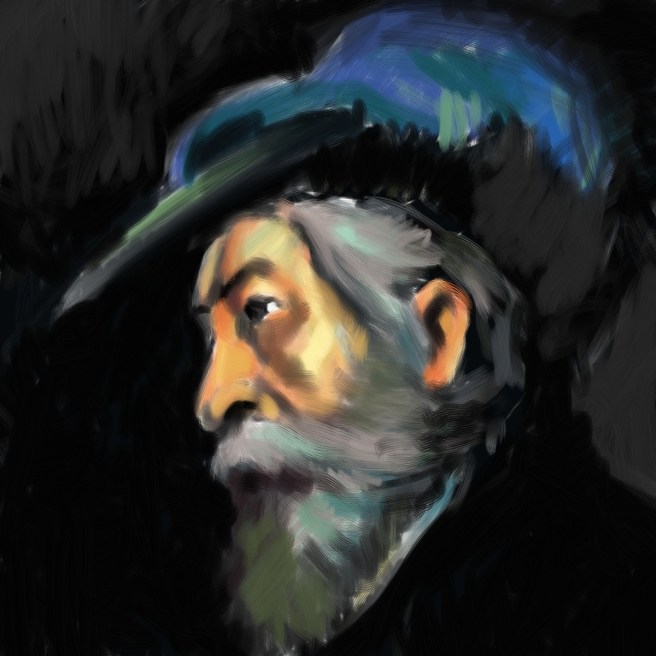
Juan Bautista de Anza jpeg
Juan Bautista de Anza

Anza’s main claim to fame is the campaign against the Comanche Indians, led by a chief named Cuerno Verde, who wore a buffalo headdress with green-painted horns, hence the name, Greenhorn. In 1779, Anza led a large force of Pueblo, Ute, and Apache Indians, along with presidial troops and New Mexican settlers, down Ute Pass through what is now Manitou Springs and Colorado Springs. This was a trail-blazing feat which is only poorly known. Known or not, the  Spanish and Indian presence here makes me feel good. I am happy that our patch of ground was the site of events important in the history of the region. The war against the Comanches is important because it shows Anza’s genius, his ability to organize an allied expedition of Native Americans, Spanish soldiers and mestizo settlers against the destructive Comanches who were raiding in New Mexico, indiscriminately attacking indigenous people and settlers. Anza took the Comanches camped along Fountain Creek by surprise, ultimately defeating and killing Cuerno Verde near what is now Walsenburg. This victory and other battles resulted in the Anza-negotiated Comanche Peace of 1786, saving the remote colony of New Mexico from likely destruction by the fierce Comanches. This puts Anza in the same league with famous American frontiersmen, people like Daniel Boone, Kit Carson, John C. Fremont, and Lewis and Clark. Yet we never hear about him. Fortunately, a group of dedicated community leaders are planning a Colorado Springs Anza Memorial at the confluence of Monument and Fountain Creeks, possible site of the first skirmish with the Comanches as Anza descended Ute Pass.

Sometimes history can play tricks on you. I was with the Anza conference attendees when we toured Taos Pueblo. On the edge of the adobe apartments of the thousand-year-old Taos Pueblo are the ruins of the church of San Geronimo, destroyed by Colonel Sterling Price’s 2nd Regiment of Missouri Mounted Volunteers and Captain John Burgwin’s 1st U.S. Dragoons in February, 1847. The New Mexican and Taos Indian insurgents had revolted against the American occupation, killed the governor imposed on them by the U.S. Army, and were now holed up in the church. I gazed at the wooden crosses in the campo santo, the church-yard cemetery, the mounds of decomposing adobe bricks, and the bell tower that still stands, repaired just enough by the Taos people to keep alive the memory of their slain compatriots. Then I saw the dragoon captain rally his troops for a charge. He was out in front. He fell, mortally wounded. At that moment I felt that I was fated to see what once was, was not now, invisible, but yet still visible. It was real to me. I suppose the experience just came from the knowledge of history.

Joe Barrera, Ph.D., is the former director of the Ethnic Studies Program at UCCS, and a combat veteran of the Vietnam War.
Issue 5 (Summer): Call for Submissions

For Issue 5 of La Revista Almagre/The Almagre Review we are looking for fiction, flash fiction and art on the themes of Race, Class, and Gender. We would like contributors to submit short stories (and other forms of fiction) that explore the realities of these social categories in the U.S.

RCG Promo graphic jpeg

To be clear, we are looking for insightful fiction that is powerful and illuminates that which divides us in society, how people engage in conflict with others, and sometimes build bridges across the divides. We want a diverse group of contributors, especially works from people of color — African Americans, Latinos/Chicanos/Hispanics, Native Americans, and Asian Americans.

We also want fiction on issues of gender, how women see themselves, their relationships to men or their refusal to be defined by their relationships to men, and of course their changing roles in society. This does not preclude male perspectives. Too often men feel that their views on gender are not valued in the discussion. We want to change that, especially in regard to how masculinity is understood.

And then there’s the issue of class. For this category we welcome the perspectives of working class people, those who are sometimes called “the working poor,” even the homeless. We would like to see an often ignored category — the white working class perspective. At the same time we realize that social class is a reality that underlies and helps to define the other two categories. What this means is that anybody can write about “class,” regardless of where she or he fits in the social hierarchy.

We don’t want the kind of writing that is typically found on blogs, or the kind of expression we hear on politically oriented talk shows, or on TV news interviews. That sort of thing has its place. However, we are looking for something deeper, and, yes, more sensitive. What we want is for you to invite others into your world, to tell them about how you see things, your perspectives, your experiences. We want to create unity. The way we see it, right now the American quilt has too many people snipping at the hems and seams, disuniting our narrative. We are looking to build an issue that allows readers to walk in someone else’s shoes — easier said than done. In spite of the cliché, “to walk in someone else’s shoes” is a much-needed experience in this polarized society of ours. And in the end, your fiction must still hold up as a well-written story.

We look forward to reading your submissions. Everything that is submitted to us is carefully considered. There is no submission fee, but in the interest of artistic solidarity, please consider buying a copy. Every cent goes into the next literary theme.

Sincerely,
Kirsten Alires, Editor
Kayla Sibigtroth, Editor
John Lewis, Principal Artist
Joe Barrera, Publisher
The Almagre Review/La Revista Almagre

A literary journal founded and published on the banks of el Rio Almagre, an ancient name for Fountain Creek, at the foot of Pikes Peak on the Front Range of the Colorado Rockies.

Joe Barrera: Christmas in South Texas

Growing up in south Texas in the 50’s we used to get Christmas presents on three different days. First there was the feast of Saint Nicholas on December 6. Saint Nicholas, a fourth-century bishop who gave gifts to poor people, is the original gift-giver whose name has morphed from the Dutch Sinter Klaas into Santa Claus. Because of him people in Europe give and receive gifts. A remnant Spanish custom survived in our small town and the children got gifts on December 6. I remember getting oranges and apples in my stocking, but never the proverbial lump of coal that the  bad kids were supposed to get. For many of the older Mexican people Dec. 6 embodied the spirit of the season, whereas Christmas was the American celebration. All the Christmas customs, the gift-giving, the decorations, etc. were absent. We didn’t have a Christmas tree, for instance, until sometime in the late 50’s. My mother found a dried branch  from the huge pecan tree in the yard. She brought it inside the house, painted it white and hung Christmas lights on it. That was the first Christmas tree I remember. It looked beautiful. Gradually, Christmas presents began to appear under the tree. By the early 60’s most of the old customs had died out and the new Christmas had taken over.

Nativity

The real celebration of “Christ’s Mass” was at church. “Misa de Gallo,” midnight mass on Christmas Eve was the important occasion and even the little kids would attend. The highlight was the procession of the children to the empty manger, to lay down the image of Baby Jesus. After mass everyone would go home and eat tamales and drink the powerful cinnamon-laced Mexican chocolate. That stuff could keep you up all night but of course that was not allowed for the children. The men had gone deer hunting and brought back plenty of venison. The women had spent hours in the kitchen marinating the meat and putting it into the corn dough wrapped in corn husks and then steaming the tamales in huge pots. There is nothing more delicious than venison tamales. For days afterward we would be eating tamales. At Christmas women ruled the house. I remember my mother and her “comadres,” which literally means “co-mothers,” making untold dozens of tamales and enjoying their sisterhood time. I sneaked in just to listen to them talk, but men were not allowed in the kitchen.

The twelve days of Christmas, December.25-January 6, had real meaning in those times. There was the joy of Christmas, but mixed with sadness, as all earthly experience must be. We remembered the Holy Innocents on Dec. 28, when all the men and boys named Inocente were honored. I often wondered how so many not-so innocent types could have that name. And how could Herod have killed so many babies? There was New Year’s Day, sacred to God the Father, who seldom gets any credit, but because of him sacred to all who bear his name, Manuel. After that there was Epiphany, on January 6, holy to all those named Epifanio. On Epiphany the Magi come bearing rich gifts. It is the Day of the Three Kings, el Dia de los Reyes Magos, the day of the Wise Men. This is also the name-day of all those named “Reyes.” In the old way of looking at things your name-day is much more significant than your birthday. The saint or sacred feast whose name you bear is your protector, a type of totem beloved in the Indo-Hispano culture.

If there was a true joyous day for all, this was it. Jan. 6 definitely eclipsed Christmas for gift-giving. Baltazar, Melchor, and Gaspar had brought gold, frankincense and myrrh to the Christ Child. We emulated them and brought our own gifts. We gave gifts to friends and family.  But in a holy time it’s the King you must honor and how can you give the King any gifts? He already has everything, owns everything. He doesn’t need your poor gift. The Irish nuns at the parish school told us so. They said that on his birthday it is the King who gives gifts. During this season we should ask the King for a favor. There is always life, but also death, and the Irish, like the Mexicans, are ever aware of death. The grace we should request, the sisters said, was for the dead–the release of dear loved ones from Purgatory. Release of captives, that was the true spirit of Christmas and Epiphany. More purified sinners are released from Purgatory at Christmas than on All Soul’s Day.

Joe Barrera, Ph.D, is the former director of the Ethnic Studies Program at UCCS, and a combat veteran of the Vietnam War.

James Stuart: Why Stories Matter

Colorado Writer, James Stuart, shares with the Almagre community the importance of stories…

farrier

The greatest storyteller I ever knew probably hasn’t written anything longer than a personal check since high school. He was a farrier from Wyoming, and even at fifteen years old, I was a couple inches taller than him. But that didn’t give me any sense of scale in his presence. He could begin telling a story at lunch, tell three more over the course of an afternoon, and wrap them all up in an intricate bow just in time for dinner. He moved effortlessly between memory, folktale, pop culture, and dirty jokes, taking with him what he liked as he went and leaving the rest on the vine. Sometimes, you found yourself a character in his stories – a small part in a grand narrative you had already lived but looked forward to hearing told anyway. More times than not, that made you a punchline. But such was his skill, you enjoyed it nonetheless.

Through my work, I have been fortunate to know a number of great writers. Some among us are just naturally gifted at turning letters and punctuation into something beautiful. I’ve swapped notes with journalists, essayists, authors, poets, and screen writers. But in spite of their skill and success, none have ever matched the raw talent of that horseshoer I met when I was young. The greatest writers among us are also the best storytellers; the reverse doesn’t exactly hold true. That is the magic of storytelling in my eyes.

Storytelling may well be our most ancient tradition, crawling into existence from the primordial soup of early communication around the same time humans began to observe the world beyond food, water, and shelter. From its earliest days, it has not been confined by any medium.  It was paint on cave walls. It was music from carved bones and strung sinew. It was mythology, parable, and fable. On cold nights, it was traded around fires, providing an additional layer of protection from a world that remained largely mysterious. It was filled with heroes, monsters, tricksters, and sirens – many of whom live on with different names today. Animals often took on human qualities to teach or to amuse. Eventually, it would be written down, printed, recorded, filmed, digitized, and monetized. But the key ingredients and basic structure have not changed over the millennia, allowing storytelling to transcend cultures, wars, famine, plague, technology, and every other obstacle in its way. It connects us with our past, while preparing new generations for the future.

Storytelling will remain relevant because it is a direct response to basic needs. The need to be understood. The need to be entertained. The need to preserve knowledge. The need to be remembered. These necessities are not only timeless, they are fundamentally human.

As such, there will always be another story to tell.

AR email Art.png

James Suart received his Bachelors Degree in English from Colorado State University in 2011. He has dedicated himself to writing fiction that is fresh, thought provoking, and occasionally profane. His influences are extremely diverse, running the gamut from Ernest Hemingway and Ray Bradbury to Zadie Smith and Jhumpa Lahari. He is also the founder of the webpage THE FORGE, a site dedicated to very brief short stories.

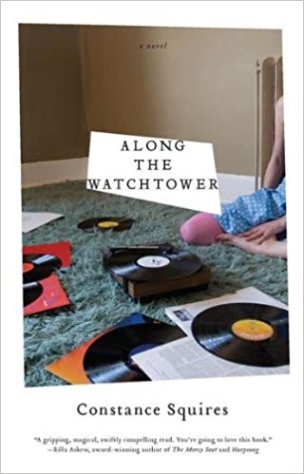
Book Chat: Along The WatchTower

In our next Issue, “Language & Music,” coming out December 26, we’re proud to feature an interview with award-winning Oklahoma author, Constance Squires, whose work has appeared in the Atlantic, Bayou, Eclectica, Identity Theory, New Delta Review, and many more.

Watchtower

Along the WatchTower (2012) is Ms. Squires first novel. Set in the 1980s, on an American army base in Germany and then in an Oklahoma small town, the novel chronicles the growing up of young Lucinda Collins, following her from adolescence on into young adulthood. We get to experience the growth of this eager-to-please, yet strong-minded woman through the world of a military family — overseas and Stateside.

The setting is something we don’t really see in fiction, that of the military family. And it would take someone with Ms. Squires’ particular talent to truly color and people an environment that is often institutional and drab. But there is no doubt, this novel is vigorous and alive.

The book gives us a wishbone with young Lucinda at the vertex and her mom on one side of the V, her father on the other. What makes the story wonderful to read is the author’s ability to deftly and clearly portray the characters’ cosmic arcs, and from the start we sense the tension bending on the bone where we find young Lucinda.

Faye Collins, Lucinda’s mother, obviously has the artist’s soul, the Creative’s gravitas; her’s is a mighty intellect harnessed into the world of being an army wife. She is always the volcano under the bulk of crust…waiting for release. The manner in which she has arrived in this marriage, as illustrated by Ms. Squires, makes complete sense. The fact that she appears unfit for the life it provides is obvious, yet her world is bruised by the desperate and inescapable need for her husband and kids — by the things they can and can’t provide.

Jack Collins, Lucinda’s father, is a relentless contradiction; the consummate military personality who is lovable and impossible to love, both devoted to the family and completely remote. Every awful action or comment for Jack is followed by a moment of redemption, which is then followed by a cold indifference, which is then followed by utter selflessness, which is then followed by callous bravado, which is then followed by incredible warmth and so on. He can piss us off. But…he also has our sympathy. One thing Ms. Squires clearly conveys is a permeant awareness, as seen by the children, the damage to men and women in the military…before caring about that sort of thing had any public traction.

This wishbone creaks from the start. It is Lucinda, our young protagonist who has to figure things out inside this arrangement. To be in the military, to grow up in that kind of family inevitably means the lowering of expectations in our friends. It’s not that we need them less, or that they’re worse…we just have to replace them all the time. So, standards might be a bit more flexible.

Throw in Rock and Roll — Punk — booze — a touch of fascistic background radiation — devastating metaphors — and we have a wonderful, coming-of-age tale spread across the Atlantic, in a setting that is too little represented in literature.

We need this author, and we need her to tell us her stories. Regardless of topic, Ms. Squires has the gift for flesh and blood. It’s impossible to think of Along The WatchTower without the people in it coming alive. For instance, Jack Collins has one of the clearest voices I’ve ever read. His dialogue crackles in the head with the clarity of a Holden Caulfield. And Ms. Squires’ energies are not wasted there; the minor characters pop as much as any.

As part of the Almagre community, we encourage you to support creative thinking, Great Storytelling, and find your way to a copy of Along The WatchTower. It is a pleasure from start to finish.

John Lewis,
Artist/Editor
AR monogram O

Again, Please. Tell Me Your Story

As fall turns to winter, I’d like to reconsider a particular reaction.AR_Fall Harvest

We have all been in the room before. Someone else is there…it might be one person, or two, or a crowd. A friend or family member begins a story. We’ve heard it already…many times.

But we let them go on out of politeness. (Is this person okay? Is he well? Does he not remember telling this story last Thanksgiving?)

This got me thinking about the importance of telling the same story again and again. First, it comes from a place of acknowledgement — I grow older, responsibilities increase, the kids acquire new demands; demands on my time, my attention, my bank account, my emotional and spiritual reservoir.

I used to think that my “elders” (I use this term carefully and loosely) were trapped in forgetfulness. At the dinner table, during or after, somehow, someway, the conversation inexorably drew to the moment where someone would re-commence the time when…

Often the details change. But what are details other than the sharp edges on a sugar cube? They don’t matter…around the pond of reminiscence, they polish down into the smooth stone of one-liners, zingers, bad accents, cued laughter. Or is it cued sadness? Either one, yes? Everything in between.

One day, not too many years ago, I noticed myself telling the same story…one I’d told many times. There was also this other strange little thought. I knew I was telling a story everyone had already heard. I knew it. They knew it. I knew that they knew it. And so on.

But, what followed proved to be an insight, albeit small. I did not care that I’d told this story before. I plowed through my social reserve and kept the performance alive, armed with those punches and zingers, cued their laughter, and delivered what my polite audience allowed. I told this story because it was a pleasure to tell. It’s always a pleasure to tell.

Why?

Because it is important. To me, it was a bright cherry along the branch of experience that is worth repeating. I have to repeat it. Others have to hear it. Memory is bad and faulty, and so much of what we live is lost along that long gray branch. But the bright cherries become the lodestars of identity. This is who I am. This is one among many stories that define the “johnness” of John to others…and to me.

Which leads me back to my original thought. That reaction! When a friend or family member begins again that story we’ve heard throughout the years…we stop, listen, and appreciate. We know they’ve told this story before. But they know it too! It does not matter.

We listen, because it is the teller’s pleasure to tell! We grant this woman or man the dignity of his or her story, the dignity of his or her life and experience. We permit them the bright cherry of identity. We listen…because it is a pleasure to listen.

John Lewis
Artist/Editor


Joe Barrera: Los Dias de los Muertos/The Days of the Dead

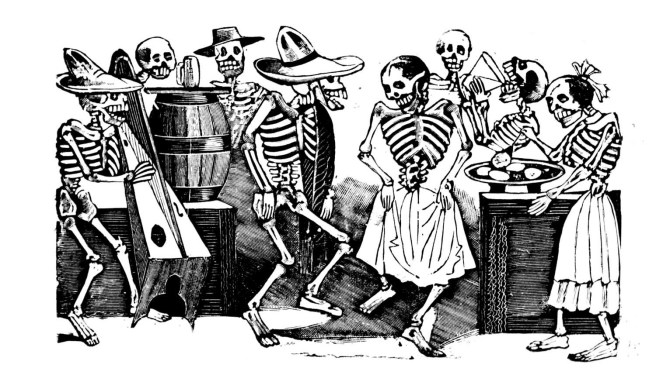
jose posada dancing skeletons
Artist: Jose Guadalupe Posada

The season of death and dying is here. Autumn brings the end of the year, the end of living things, the end of growth in the cold of winter. October 31, All Hallows’ Eve, Halloween, albeit much altered from its original intent, is a celebration of the end of the harvest but also a recognition of the presence of the dead on earth. Originally, Halloween was the time when ghosts of the dead, along with unholy spirits, were given free rein to roam the earth before they were again confined in Purgatory or in Hell. They had to be confined in anticipation of November 1, the Day of All Hallows, the Holy Ones, the saints in heaven. All Saints is followed by All Souls on November 2, during which we honor the Souls in Purgatory, suffering purification before entry to heaven in the Catholic belief that was once universal in Europe. The season is the last vestige in modern culture of the reality that life and death are two sides of the same coin, that where there is life there must also be death, that the same Creator who created life also created death. The season tells us that we should not ignore death, nor fear it, because it is part of our existence and we cannot avoid it. In our culture, which deludes us into believing that youth and physical beauty are eternal, we don’t pay much heed to this kind of thing anymore.

Our Halloween customs derive from northern Europe, but traditions known as The Days of the Dead, usually the last days of October and first days of November, have come in from lands to the south. These influences are often mistakenly considered to be “Mexican Halloween,” but Halloween and The Days of the Dead are very different celebrations. In Mexico, death is traditionally honored in a much more open fashion than it is here. Death is held in high esteem, in a reverential sense, not in the spooky, haunted sense of Halloween.

Awareness of the dead is typical of a culture that looks to the past, as in Mexico, not of a future-oriented culture as in the U.S. In Mexico, which is strongly mindful of the past, the amalgamation of Iberian Catholicism, full of ancient Greek and Roman roots, with the indigenous religions of the Aztecs, has given rise to a rich tradition known as los Dias de los Muertos, or The Days of the Dead. We enjoy the celebration here in spite of the cultural differences. A manifestation of this in U.S. culture is the creation of “altares,” altars in remembrance of deceased friends or relatives. These are  commonly found in art galleries, where they are seen as opportunities for artistic license. In Mexico, altars to the dead are found in many homes. They are sincere tributes to loved ones, not art installations. Portraits of the departed are displayed, and their favorite food, drink, cigarettes, personal items, etc. are laid out in anticipation of their earthly visitations. The intent is to honor the deceased out of love and affection but also from a profound sense of the very thin veil that separates this life from the other life. In some ways, The Days of the Dead resemble American Memorial Day. Families in Mexico go to cemeteries to visit and adorn the tombs and to share meals with the dead. This is something which we should respect.

The veil separating life and death is indeed flimsy. We must realize that we will all soon be dead. What happens then? The Mexican artist, Jose Guadalupe Posada, is famous for his depictions of skeletons behaving as if they were still alive, enjoying all the pleasures of human life–food, drink, fancy clothes, parties, dancing, even sex. Posada’s skulls and bones in the midst of carnal pleasures symbolize the union of life and death. They also warn us of the illusory nature of pleasure. His art has been appropriated by the dominant U.S. culture and is now found everywhere. But his ideas have not. We see the dancing, drunken, fornicating skeletons as just funny art, missing the point of the illusion of human existence and the much more real intimacy of life and death.

The Days of the Dead celebration in U.S. culture is an example of cultural blending, something which always happens when distinct cultures rub against each other, as is the case in this part of the country. This can be good because cross-fertilization like this saves U.S. culture from stagnation. It goes the other way, too. Mexican culture is influenced by American culture. However, the popularity of The Days of the Dead is an appropriation by the American dominant culture of an element from the subordinate Mexican culture. As such, the meaning of the celebration has been altered. Things get changed when cultural elements are removed from their original context. They diverge from their original meanings. They may be  trivialized, stripped of serious meaning, made into “kitsch,” becoming pretentious, shallow and gaudy. This is what has happened to The Days of the Dead in the U.S. The sacred meaning of Los Dias de los Muertos has been lost.  This sacredness can be understood to be an escape from human rationalism, a journey into a space of intense, passionate, personal religion, a religion not about obeying God but more about one’s relationship with the physical world and simultaneously with the spiritual world. This is a religion of beauty, and definitely not one of fear of death and punishment for sins, but one of love in a space where loved ones await living human beings, who are the soon-to-be dead.

Joe Barrera, Ph.D., is the former director of the Ethnic Studies Program at UCCS, and a combat veteran of the Vietnam War.

business-card-monogram

Issue 3, Environment; An Exciting Edition on its Way

Here at the Almagre, we are thrilled about our upcoming issue (Publication in JUNE). This will be a great opportunity for Colorado readers and writers to experience fantastic local talent alongside voices from all over (and we do mean all over!). There is, of course, the interview with famed Southwest writer, John Nichols, sharing insight about his environmental philosophy and the ways it manifests in his writing.

But this issue will feature much, much more. Readers will find contributors from all over the country whose work has appeared in other prestigious publications such as the Massachusetts Review, TriQuarterly, Asimov’s Science Fiction, The Sun, and others. We have words penned by some of Colorado Springs’ finest talent as well as beautiful poems from as far away as India and the Netherlands.

These are exciting times for Colorado Springs’ newest literary journal, and we’re asking those who are passionate about art and narrative to come join us. Spread the word to friends, to family, to fellow authors and artists. Absolutely everything we make from this passion-project pours back into the pages which carry the magic of the written word. Come help us tell the story of America.

          With Gratitude,
          The Staff of La Revista Almagre


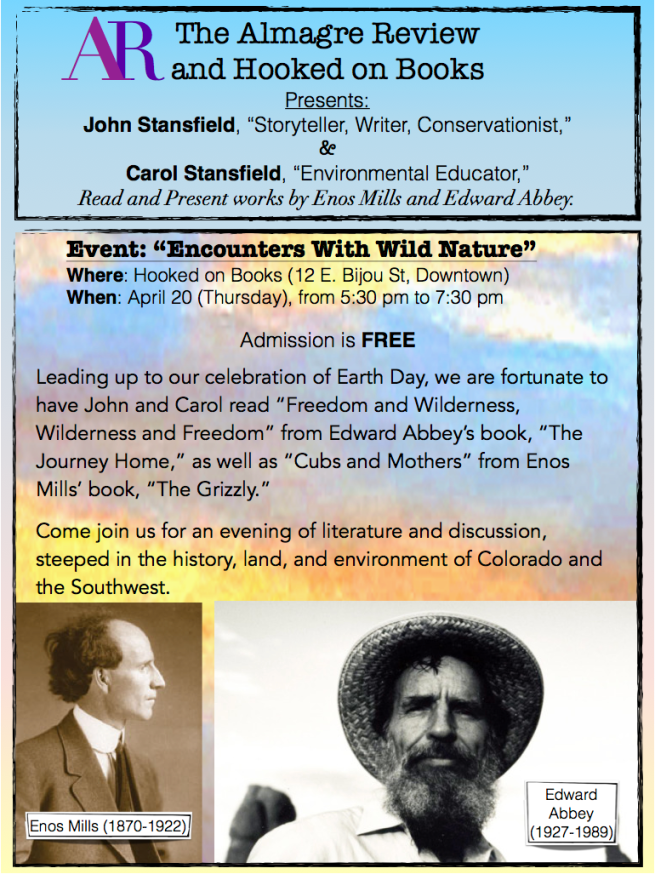
John & Carol Stansfield Present The Almagre Review’s Second Literary Event: April 20 @ Hooked On Books

Come join us for our second literary salon in anticipation of Earth Day. Thursday afternoon (5:30 pm to 7:30 pm), John and Carol Stansfield will read authors Edward Abbey and Enos Mills, downtown @ Hooked On Books. Admission is FREE!