Issue 5 (Summer): Call for Submissions

For Issue 5 of La Revista Almagre/The Almagre Review we are looking for fiction, flash fiction and art on the themes of Race, Class, and Gender. We would like contributors to submit short stories (and other forms of fiction) that explore the realities of these social categories in the U.S.
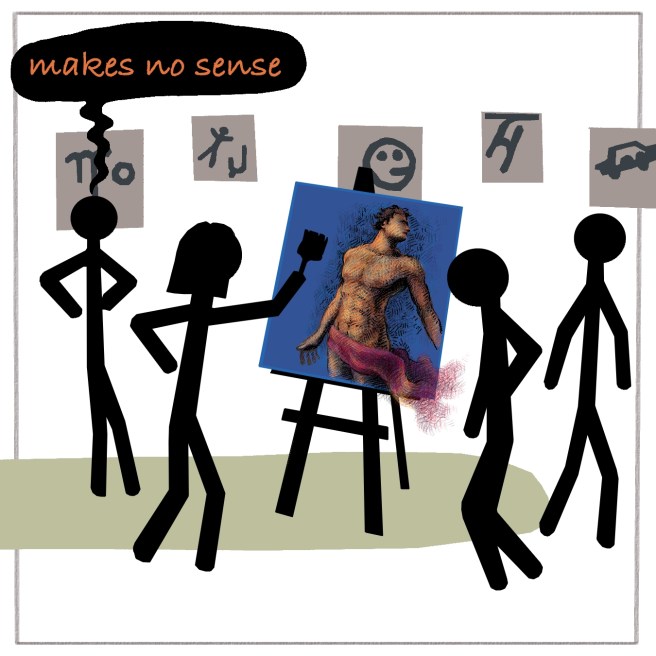
RCG Promo graphic jpeg

To be clear, we are looking for insightful fiction that is powerful and illuminates that which divides us in society, how people engage in conflict with others, and sometimes build bridges across the divides. We want a diverse group of contributors, especially works from people of color — African Americans, Latinos/Chicanos/Hispanics, Native Americans, and Asian Americans.

We also want fiction on issues of gender, how women see themselves, their relationships to men or their refusal to be defined by their relationships to men, and of course their changing roles in society. This does not preclude male perspectives. Too often men feel that their views on gender are not valued in the discussion. We want to change that, especially in regard to how masculinity is understood.

And then there’s the issue of class. For this category we welcome the perspectives of working class people, those who are sometimes called “the working poor,” even the homeless. We would like to see an often ignored category — the white working class perspective. At the same time we realize that social class is a reality that underlies and helps to define the other two categories. What this means is that anybody can write about “class,” regardless of where she or he fits in the social hierarchy.

We don’t want the kind of writing that is typically found on blogs, or the kind of expression we hear on politically oriented talk shows, or on TV news interviews. That sort of thing has its place. However, we are looking for something deeper, and, yes, more sensitive. What we want is for you to invite others into your world, to tell them about how you see things, your perspectives, your experiences. We want to create unity. The way we see it, right now the American quilt has too many people snipping at the hems and seams, disuniting our narrative. We are looking to build an issue that allows readers to walk in someone else’s shoes — easier said than done. In spite of the cliché, “to walk in someone else’s shoes” is a much-needed experience in this polarized society of ours. And in the end, your fiction must still hold up as a well-written story.

We look forward to reading your submissions. Everything that is submitted to us is carefully considered. There is no submission fee, but in the interest of artistic solidarity, please consider buying a copy. Every cent goes into the next literary theme.

Sincerely,
Kirsten Alires, Editor
Kayla Sibigtroth, Editor
John Lewis, Principal Artist
Joe Barrera, Publisher
The Almagre Review/La Revista Almagre

A literary journal founded and published on the banks of el Rio Almagre, an ancient name for Fountain Creek, at the foot of Pikes Peak on the Front Range of the Colorado Rockies.

James Stuart: Why Stories Matter

Colorado Writer, James Stuart, shares with the Almagre community the importance of stories…

farrier

The greatest storyteller I ever knew probably hasn’t written anything longer than a personal check since high school. He was a farrier from Wyoming, and even at fifteen years old, I was a couple inches taller than him. But that didn’t give me any sense of scale in his presence. He could begin telling a story at lunch, tell three more over the course of an afternoon, and wrap them all up in an intricate bow just in time for dinner. He moved effortlessly between memory, folktale, pop culture, and dirty jokes, taking with him what he liked as he went and leaving the rest on the vine. Sometimes, you found yourself a character in his stories – a small part in a grand narrative you had already lived but looked forward to hearing told anyway. More times than not, that made you a punchline. But such was his skill, you enjoyed it nonetheless.

Through my work, I have been fortunate to know a number of great writers. Some among us are just naturally gifted at turning letters and punctuation into something beautiful. I’ve swapped notes with journalists, essayists, authors, poets, and screen writers. But in spite of their skill and success, none have ever matched the raw talent of that horseshoer I met when I was young. The greatest writers among us are also the best storytellers; the reverse doesn’t exactly hold true. That is the magic of storytelling in my eyes.

Storytelling may well be our most ancient tradition, crawling into existence from the primordial soup of early communication around the same time humans began to observe the world beyond food, water, and shelter. From its earliest days, it has not been confined by any medium.  It was paint on cave walls. It was music from carved bones and strung sinew. It was mythology, parable, and fable. On cold nights, it was traded around fires, providing an additional layer of protection from a world that remained largely mysterious. It was filled with heroes, monsters, tricksters, and sirens – many of whom live on with different names today. Animals often took on human qualities to teach or to amuse. Eventually, it would be written down, printed, recorded, filmed, digitized, and monetized. But the key ingredients and basic structure have not changed over the millennia, allowing storytelling to transcend cultures, wars, famine, plague, technology, and every other obstacle in its way. It connects us with our past, while preparing new generations for the future.

Storytelling will remain relevant because it is a direct response to basic needs. The need to be understood. The need to be entertained. The need to preserve knowledge. The need to be remembered. These necessities are not only timeless, they are fundamentally human.

As such, there will always be another story to tell.

AR email Art.png

James Suart received his Bachelors Degree in English from Colorado State University in 2011. He has dedicated himself to writing fiction that is fresh, thought provoking, and occasionally profane. His influences are extremely diverse, running the gamut from Ernest Hemingway and Ray Bradbury to Zadie Smith and Jhumpa Lahari. He is also the founder of the webpage THE FORGE, a site dedicated to very brief short stories.

Why We Write: 1

The question reminds me of Nabokov, who having written Lolita, experienced the relentless question, “Why did you write that book,” or, “What is it about?” Of course, audiences and critics had their own ideas.

Nabokov tired of other people telling him what the story was about–explaining that he wrote Lolita simply to “participate in the ecstatic.” When we discuss relationships between a creative work and an individual, we describe the relationship in many ways: perhaps joy, or offense, a profoundly spiritual feeling…or simply fun! Maybe a creative work goes unregistered. Ah! The unrequited…

But for those who are creative…painters, sculptors, musicians, writers! We understand Nabokov’s words–Ecstasy, experienced during the act of creation. Over the years, I can’t recall a Creative at work who wore the face of serenity. Rather, to me, it always looks like an expression of concentration sourced through meaning. One is precisely where they ought to be during the act.

Christopher Hitchens once advised an audience about this very notion. According to him, a writer writes not because he wants to, but because he has to. For writers, this is obvious. There is something inside us, and it must come out. To hold it inside is to take a vow of celibacy. Writers who don’t write, (painters who don’t paint, musicians who won’t play, etc.), are living a celibate lifestyle.

Back to Nabokov. Anyone who has spent time involved in artistic creation knows the feeling. Ecstasy. I find over the years that writing becomes no less arduous. In fact, it seems to become harder. Words are more carefully chosen, phrases more measured, plotting instincts subjected to increased scrutiny.

But the magic happens. With the blessing of the “muse,” we roll into another region of the mind. The turbid, whirling mass behind the wall of conscious and conscientious manners, of deliberate and logical thinking, becomes accessible. It’s quite extraordinary. Powerful. And, it is the bringer of fervent artistic creation along with its accompanying devils: doubt, fear, self-abuse. We must deal with these in the aftermath. In the tempest, however, is the ecstasy Nabokov refers to where what had seemed impossible becomes more than that…it becomes inevitable. The universe of a novel or painting or album pulls together of its own volition, because the mass and inertia is too large for one person to do it deliberately. But somehow it happens–the universe briefly organizes, the impossible has become inevitable–and only because the artist has become the medium for that volition.

Afterwards…we beg off for awhile, collect ourselves, and begin again the process of inviting the muse.

Uro-bureaus
Uro-bureaus

Why We Read: 2

Being a project dedicated to growing Colorado literature, we ask ourselves this question at the Almagre quite a bit. Why build a journal, paper no less, and expect others to read it?

For us, the easy answer is this: pick up a copy of Issue 3, open it, fan the pages, breathe in the spine’s scent. Take it, sit with it, create a silent space. Then…explore the poems within, the stories, the essays, the art. We know that the Authors and Artists in Issue 3 will give any reader their money back many times over…restored in full with ideas, new perspectives, as-yet-learned words, and renewed optimism in the power of imagination.

But that is self-serving. And it’s really about more than our journal. It’s about participation in all that’s going on. Literature promises truth; and that is even when it distorts history, or kneads it, bends it, warps it, or is about hypocrites and thieves and liars; or deals with gouging, skullduggery, banditry, or lowlifes. Literature promises truth, because it triangulates around it, shines a flashlight one way, then another, producing a changing shadow that can provide deeper understanding. The point is, literature begs us to know that any given subject requires curiosity and examination from multiple angles. This curiosity should never end.

We’ve entered an age of alternative facts…and that is a worrying thing. In certain venues, we prefer it one way—facts as facts—a thing which doesn’t build on alternatives but on additions. With literature (fiction and nonfiction), we are faced with an honest proposition: “Here is my side of the story,” or, “Here is a side of the story.” By taking the time to do this, we acknowledge that a gain in understanding is a journey. A matter of course. For those who believe they have reached a destination, we feel pity.

To read is to fend ignorance, acquire knowledge and wisdom, to join the polity as those who would prevent a world of alternative facts. For many of us, it is the way forward.

With Profound Gratitude to all our Readers,

Editor & Artist, John Lewis


Issue 3, Environment; An Exciting Edition on its Way

Here at the Almagre, we are thrilled about our upcoming issue (Publication in JUNE). This will be a great opportunity for Colorado readers and writers to experience fantastic local talent alongside voices from all over (and we do mean all over!). There is, of course, the interview with famed Southwest writer, John Nichols, sharing insight about his environmental philosophy and the ways it manifests in his writing.

But this issue will feature much, much more. Readers will find contributors from all over the country whose work has appeared in other prestigious publications such as the Massachusetts Review, TriQuarterly, Asimov’s Science Fiction, The Sun, and others. We have words penned by some of Colorado Springs’ finest talent as well as beautiful poems from as far away as India and the Netherlands.

These are exciting times for Colorado Springs’ newest literary journal, and we’re asking those who are passionate about art and narrative to come join us. Spread the word to friends, to family, to fellow authors and artists. Absolutely everything we make from this passion-project pours back into the pages which carry the magic of the written word. Come help us tell the story of America.

          With Gratitude,
          The Staff of La Revista Almagre


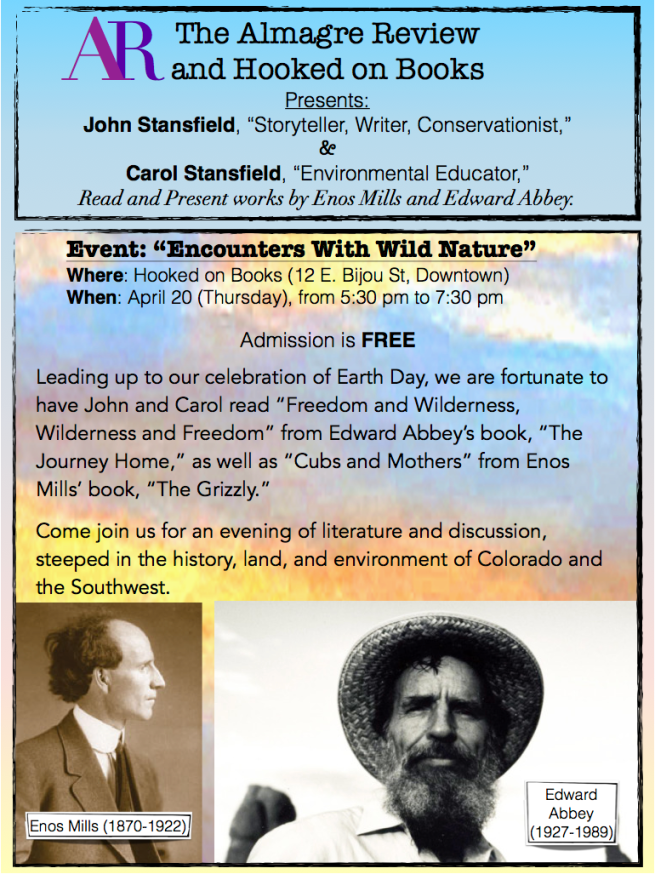
John & Carol Stansfield Present The Almagre Review’s Second Literary Event: April 20 @ Hooked On Books

Come join us for our second literary salon in anticipation of Earth Day. Thursday afternoon (5:30 pm to 7:30 pm), John and Carol Stansfield will read authors Edward Abbey and Enos Mills, downtown @ Hooked On Books. Admission is FREE!

Janice Gould Presents at Colorado College

Error
This video doesn’t exist

The Almagre Review’s first literary salon, April 6, at Colorado College. Janice Gould and the audience read and discuss feminist author, Kate Chopin, and her fiction piece, “The Story of an Hour.”

Almagre Upcoming Events; from the Publisher

Dear Friends,

Once again, we share with you news from The Almagre Review. We interviewed famed Taos writer John T. Nichols, the author of the Milagro Beanfield War trilogy, in January, 2017. The Almagre Review will soon publish our Environmental Issue, with an excerpt from the John Nichols interview featuring his environmental philosophy for which he is famous.

We are also planning a Symposium on Sustainability and the New Agriculture. We anticipate that Colorado businessman and organic rancher Mike Callicrate will participate. Also soon to come, we are scheduling The Almagre Review Literary Salons. Our first Salon will be with Janice Gould, former Poet Laureate of Colorado, who will lead a reading and discussion of Kate Chopin’s, “Story of an Hour.” This is a very short story (about 2 pages) which we will read on April 6 at the Salon (location and time TBA).

In May, I will lead a reading and discussion of Ernest Hemingway’s, “Soldier’s Home,” another very short story.

Regards,
Joe Barrera,
Publisher

business-card-monogram

Announcing the Theme for Issue 4: Language & Music

Issue #3, Environment, is coming together. Today, we’re revealing the theme for issue #4, LANGUAGE & MUSIC, which will appear at the bottom half of 2017.

What are we looking for? Well, language is music, que no? Send us an original poem in french, with the english translation to accompany it. Send us a brief memoir in spanish to appear beside its english transcript. Or… a caption in farsi. Why? Because the script of a language might simply look musical to the uninitiated. Interested in fiction? Share a story about a Delta blues musician, a college music major, or a Senegalese rapper. A poem might double as a song lyric. The point is, language and music in this issue will be explored in relation to each other. To speak is to carve air. To pluck a guitar is to pattern it. Make us fall in love with the melody in your prose.

As always, surprise us with your original best. The privilege is ours! Questions, email John or Joe @ larevistaalmagre@outlook.com

taos-farsi-script
from the Divan, -Hafiz

Issue 2, December, Promises Special Contributors

When Joe and I started The Almagre Review/La Revista Almagre, we wanted to build a journal that promotes local and regional talent. Often, the most important voices are the ones yet to be discovered. Our goal is to be a stepping stone in helping these authors along their journey toward literary success.

It’s with pleasure we share that two very special contributors will appear in our next issue; Clay Jenkinson and Mike Callicrate. Mr. Jenkinson is the creator of The Thomas Jefferson Hour heard every week on NPR, and Mike Callicrate is the owner of Ranch Foods Direct. As pleased as we are that both of them join us in conversation, it’s the up-and-coming authors that form the spirit of our publication.

The Staff at The Almagre are dedicated to building issues where new talent can appear beside established voices. We do this as a way of saying, no matter where you are in your literary trajectory, our pages welcome people of all backgrounds. We might buy an issue because someone we love to read is in there, but one of the chief delights is discovering a new favorite author who enriches our future reading experience.

promo-card-jpeg