Issue 2: “Leadership” has Arrived!

It’s official, announcing the arrival of Issue Two.

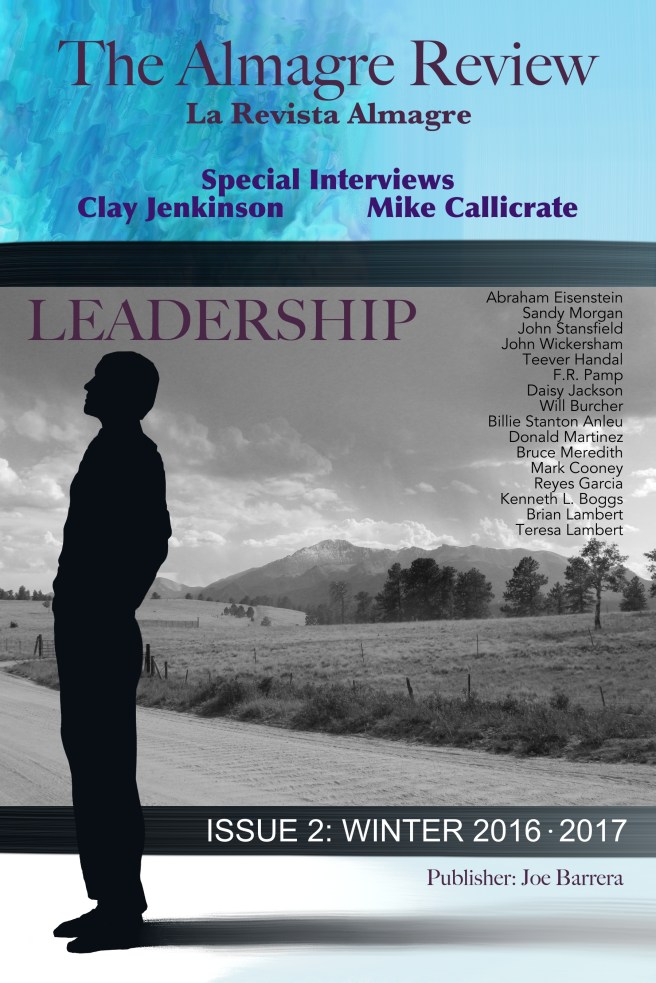
leadership-cover-2jpeg

The Almagre Review/La Revista Almagre is excited to share the publication of our second issue. We have wonderful local contributors, writers from up and down the front range, from the prairie, all the way to Wisconsin. To purchase a copy online, click HERE ($12 plus shipping). Copies are also available at the downtown locations of Hooked On Books and Poor Richards.

The Almagre Review will be at the Manitou Art Center on December 16th for their art opening. Copies of issues one and two will be available for purchase. Stay tuned for additional dates and events.

Warm Regards,

The Almagre Staff

Contemporary Heroes; Hooked On Books

Yes, in the spirit of leadership, the theme of issue two, we’d like to honor bookstores and especially their proprietors.

The Almagre Review wants to take a minute to thank Hooked On Books for their enduring dedication to Colorado Springs’s local authors. One might not realize this, but Jim and Mary Ciletti devote a tremendous amount of time and resource to writers who publish and sell their work locally.

The bookstore, we all know, is a diminished institution. This is not because we read less than we used to; that is a misconception. We read more than ever. But, we read differently. Deep attention to long, rich works grows scarcer by the year. We collect information like grains of sand blowing through the air. News by captions! This is the age of trying to form complex world-views out of a chaotic constellation of information. Our contemporary consumption of the written word has conferred all its disadvantages upon the local bookstore.

Companies like Barnes and Noble can manage, but even then, not all the large companies survive–Borders went out of business. And for the mom and pops bookstore? To find one is a treasure, to support them–a public service. There’s a touch of the heroic, born of faithful dedication, to Jim and Mary Ciletti for their labors in sustaining a brick and mortar location for story enthusiasts like us.

As a gesture of friendship, take the time to stop by Hooked On Books, or any bookstore. The Almagre recommends this from a place of deep gratitude. While there, let Mary or Jim know, that it was at the urging of Colorado’s newest literary journal. Most importantly, ask the proprietor, “what book by a local author do you suggest today?”

bookstore-graphic

Los Dias de los Muertos – The Days of the Dead

MVCD Button
We are in the autumn of the year. Another year falling down to die in December. We roll past All Saints and All Souls, remembering Heaven and Purgatory, the days of the dead, los Dias de los Muertos, as we say in Spanish.

Autumn is like that, bringing remembrances of the dead. But memory is strange. Instead of dying, memories come to life, more real than the people and events from which they spring. My memories are of the Vietnam War, rapidly receding into the distant past, and of the soldiers who populate those memories. Soldiers appear, stand and speak. They come to petition, to ask for my favor.

Sometimes I cannot answer them. They are too insistent, wanting to hold me accountable lest I forget them. The dead of the Vietnam War, like the dead of all wars, wish only to be remembered. But the Vietnam dead have a special poignancy about them. They do not want to be consigned to the gray world of shameful memories, even if their war is often perceived that way.

So I am patient with them. And I am patient with myself. Before I had Vietnam memories, I had other memories, the World War II stories that I heard growing up. I came home from the Vietnam War in 1968, in the autumn of the year. I came home to south Texas. I was a combat veteran, home from the war, but yet not home, unable to return to the civilian world, as combat veterans often cannot.

But it was a good homecoming. My uncle was there to greet me. He was an old soldier. He had landed with the Second Infantry Division on D+1, June 7, 1944. Reynaldo V. Zuniga, that was my uncle’s name. When I think of my war I always think of him. I remember the stories he would tell.

My uncle would sit with his cronies, among them another combat veteran named Ray Hernandez, who had been with the 36th Division, the Texas National Guard outfit savagely mauled by the Germans at the Gari river in Italy and finally at Monte Cassino. There was another man, a small, quiet, dark-skinned man. This man’s name was Jose Lopez. He would come to visit relatives in Brownsville, then stop to visit my uncle before returning to San Antonio. They had been in the same regiment during the war, Jose Lopez in M Company.

In December 1944 he killed 132 Germans in and around the Belgian village of Krinkeldt. He shot them down with his .30 caliber machine gun. He was alone. His comrades had fled in the face of the German onslaught. For that action during the Battle of the Bulge Jose Lopez won the Medal of Honor.

The stories would usually start on D-Day. That was my uncle’s glory. He jumped off the ramp of the LCI, into water that nearly covered his head. “I held up the man next to me,” he would say. “I’m six feet-two, so I saved him from drowning. And the Germans were still shooting at us.”

He was seventeen when he ran away from home in 1940 together with his best friend, Ernesto Vela. The boys hitchhiked to San Antonio and joined the Army’s Second Infantry Division, the famous Indian Head division. The profile of the stoical Indian warrior is the proud insignia of the Second Division, a fitting symbol for the many south Texas Mexican Americans who fought, bled and died in that combat division in World War II.

Ernesto was killed in Normandy. He lies in the American cemetery at Colville-sur-Mer, overlooking Bloody Omaha, the beach where so many men died. My uncle still talked about him many years later, and I would listen, listen so much that I felt that I knew Ernesto, that he was my comrade, too.

He was rapidly promoted and was very soon an NCO, the platoon sergeant, even if he was a hard drinker and a hard brawler, ready with his fists and even more ready with his sarcasm. But he had leadership qualities. I remember that he was a natural leader and I certainly wanted to follow him.

My uncle lasted three months in combat. He was wounded three times. The last wound was almost fatal. It was in September, 1944. The U.S. Second Infantry Division was now part of Patton’s newly activated Third Army, tasked with clearing the Germans out of the Brittany peninsula and liberating the port city of Brest.

Reynaldo Zuniga was a platoon sergeant in I Company, 3rd Battalion, 23rd Infantry Regiment. He led from the front, always from the front. He was that kind of man. He ran out in front of his men, and I can hear him shout, “follow me!” It was at the siege of Brest.

Then he was shot. A German soldier hiding behind a wall shot him with a K98 Mauser rifle, the 7.92 mm  slug shattering his pelvis. He lay on the ground, “and the blood was pouring out of me like water from a faucet,” he would say. The platoon medic ran out, oblivious to danger, slapped a pressure bandage on him and pulled him to safety. “The Germans were so close that I could hear them talking, but they didn’t shoot the medic and they didn’t shoot me again.” I can still hear him say that, paying a grudging compliment to the enemy who had nearly killed him but then chose to spare him.

On Veterans’ Day I drank a toast to him. I went to my war because I wanted to be like him. But of course I never could ascend to that lofty height. We old soldiers continue to fight our wars. It’s a type of relief to tell stories, especially among the bands of brothers found in every VFW and American Legion post across the land.  I have done that, and gone on pilgrimages looking for solace.

When I visited the Vietnam War Memorial in Washington – The Wall – I tried to put mine to rest. I touched the names of comrades engraved there. It’s a powerful experience and it’s no accident that the Memorial to the Vietnam War dead is a wall – we, the survivors – are still trying to go through our own wall. We want to finish our war and reunite with our comrades. It’s tragic that so many Vietnam veterans cannot do that.

When I went to the Wall I think that I succeeded, at least to a small degree, in putting my war to rest. Touching their names gave me a fleeting connection to those long-dead comrades.

But there was another bond that I found there. It made me feel another strong emotion. The Wall has one unique feature that I immediately noticed. No where else, on no other American monument, civilian or military, are there so many Spanish surnames. On every panel there are Mexican, Puerto Rican, Cuban, Central American names. Thousands of them.

The Vietnam War Memorial is an ironic testament to affirmative action. That Roll of Honor is the only place where our country gives Latinos the recognition we so richly deserve – because it was paid for in blood.

~Joe Barrera,
Publisher/Editor
The Almagre Review

business-card-monogram

A Profound Thank You to Our Veterans

MVCD Button
Joe and I would like extend our thanks and gratitude to the men and women who have defended our country.

I have been privileged to share in this venture, our humble publication, with Joe, who served in Vietnam. I think of him as a dear, and unlikely friend, for the fact that we came together over this project from different backgrounds and different generations. It has been an honor to hear some of his stories, and to be exposed to new insights and thoughts that only a veteran can share. I think of Joe as part of the family… and he has joined my family at the dinner table many times.

When we set out to build The Almagre Review, one of the things we wrote into the ethos of our journal is that, “we consider ourselves a friendly home to veterans.”

There are publications out there which are dedicated to soldiers and their tales. There are also mainstream literary journals, and one will occasionally encounter soldiers’ tales in them. At our journal, we’d like to somewhat dissolve those borders, and be a publication for the mainstream public where one commonly finds words penned by America’s military women and men.

And… about those dinners with Joe. Certainly, we talk about literature, about politics, about art. We talk about our journal, our writing. But mostly, he sees to it to talk about my family, the kids, my wife, and to remind me how special they are. This is where we always end up. And it’s the least I can do for him… share a place at the table, with my family, for whom he feels great affection.

It’s an honor, that we at The Almagre Review, can offer our pages to veterans as if it is the family dinner table. We welcome writers of all backgrounds, but we pay particular attention to the words of those who have served.

Again, a profound thank you to our veterans
~The Almagre Staff

Issue 2, December, Promises Special Contributors

When Joe and I started The Almagre Review/La Revista Almagre, we wanted to build a journal that promotes local and regional talent. Often, the most important voices are the ones yet to be discovered. Our goal is to be a stepping stone in helping these authors along their journey toward literary success.

It’s with pleasure we share that two very special contributors will appear in our next issue; Clay Jenkinson and Mike Callicrate. Mr. Jenkinson is the creator of The Thomas Jefferson Hour heard every week on NPR, and Mike Callicrate is the owner of Ranch Foods Direct. As pleased as we are that both of them join us in conversation, it’s the up-and-coming authors that form the spirit of our publication.

The Staff at The Almagre are dedicated to building issues where new talent can appear beside established voices. We do this as a way of saying, no matter where you are in your literary trajectory, our pages welcome people of all backgrounds. We might buy an issue because someone we love to read is in there, but one of the chief delights is discovering a new favorite author who enriches our future reading experience.

promo-card-jpeg

Why Readers Matter

image1Our publication’s newest reader. And we’re thankful to the parent of this greatness-in-the-making for sharing such a candid moment!

Writers ask a lot of their readers. It’s more than just time. The solicitation is quite intimate, begging more of a total investment.

We can’t speak for everyone, but here at our humble publication, we know how slippery and temporary ideas are…all ideas, great ones especially. Once committed to paper, an idea finds a quasi-permanence.

So in the age where most stories are told through moving images and sound, the written word in all its static glory must rely on its most powerful quality. That quality is this intimacy…the theater of another’s mind. Here, a poem or novel moves in, like a circus, it sets up camp, unfolds its tents, un-carriages the animals, and builds a show between the ears of another human. Think of this invitation, this opportunity to inhabit each other. It’s a unique dialogue. When the reader shares his time with all those set pieces stored in the attic of his imagination, those wares built from the thread of experience, he gives the writer her reason to be. He also gives her the stage for her ideas. The necessary loop is complete and the current can flow.

We all remember that thing the last exquisite novel provided which a movie cannot produce. The scenes and scents and people moved through our head. We were not passengers, we were not emotional patients strapped to the operating table. We were part of the story. In some ways, it was even about us.

Thank you to our readers who have taken the time to be a part of our journey. We look forward to the big sky horizon of the West and all the future stories waiting to fill our pages.

~John Lewis,
Artist/Editor
orange

Reflecting on Leadership through the book, “The Character of Meriwether Lewis”

Clay Jenkinson Book

A wonderful book! Clay Jenkinson explores Meriwether’s character and leadership like a geologist in the field, not a benchtop analyst in the lab. This is an intimate journey; he does not simply put the specimen under a magnifying glass and jot down a detailed list. He picks the matter up, rotates it, puts it under various lights, illuminates the textures, and manages to pluck a real person out of the shady bin of historical mythology. Lewis becomes someone we start to know.

What works well in this narrative is the use of various angles to explain the subject. One encounters John Donne, Dickens, L. Ron Hubbard, Eric Sevareid, etc., as vehicles to clarify the complexities of Meriwether’s difficult, sometimes overwrought nature. Clay’s application of Donne’s poetic conceit, likening Lewis and Clark to a fusion core, is an example of successfully using this approach. The polarity of prose is also effective. One goes from literary metaphors, Jefferson’s “theater” of grief in Virginia after his wife dies, Lewis’s “attic” of isolation and anxiety as governor, to the vernacular of being, “shot in the ass.” Whether this works for all is difficult to say, but it contributed to the book’s wonderful readability. In a page, one might laugh out loud, then delight in the discovery of a new word (“hendiadys”), next to feeling sadness over the tragic and rapid decline of Lewis.

One also appreciates Clay’s integrity to truth. It’s quite a feat, to bring to life and humanize someone as mythologized as his subject, yet maintain a constant fidelity to fact. The narrative never veers off into wild speculation, nor does it favor sensationalist assertions over strongly argued conclusions. The reader is led down a rational, sober, extremely interesting path, and Clay offers compelling insight as to how events affected Lewis and helped to lead him to his end.

A supremely interesting narrative about the complex character of one of America’s greatest leaders.

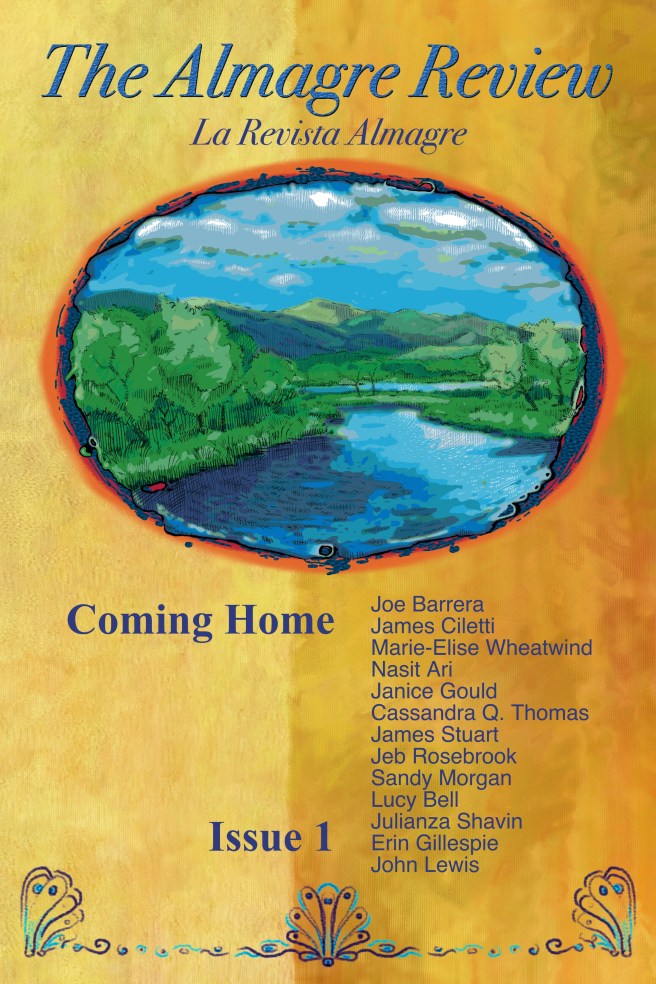
Publication of Issue One : Coming Home

Join The Almagre Review @ Hooked On Books (downtown), 12 e. Bijou Street, tomorrow night from 4:30 pm to 7:30 pm. Our first issue is officially published and will be available for purchase. Refreshments will be provided and contributors will read their works live. We look forward to seeing everyone there.

Almagre Cover (Premier)jpeg

Veterans Community Dialogue: Last Saturday

MVCD Button
This…was an experience well worth witnessing.  As Joe speaks about the healing process, these dialogues make it apparent to anyone who comes.

To be a civilian means I don’t get to look through this door very often.  It’s always a privilege when I do.  These are a wonderful opportunity for family and friends to listen, and to participate.  The treasure in these events is the very fact that Joe works to include the voice of spouses, even the children.  Last Saturday was informal, intimate… a comfortable setting.

There were difficult things to hear.  There were moments of great laughter.  The honesty shared by the attendees felt heavy, arresting, illuminating, and courageous.  When asked the question, “which is harder, adjusting to war, or adjusting to coming home?” the veterans unanimously chuckled and said, “adjusting to home.”

What more can be said to emphasize the value of all those at home to engage in and be a part of the healing process for their loved ones?

The Almagre Review thanks all our veterans for their service, and for the honor of attending the Military Veteran’s Community Dialogue.

~John Lewis,
Artist/Editor

About Issue 1

THE ALMAGRE REVIEW

Issue Number One 

Summer 2016

Coming Home

by Joe Barrera, publisher

Colorado Springs Downtown (1880)jpeg

We would like to inaugurate our new literary journal, The Almagre Review/La Revista Almagre, with the theme of “Coming Home.” The theme of coming home is not uncommon in literature. “Home” always provokes nostalgia, a return to roots and a sense of security which no other human experience can duplicate. In our case, “coming home” suggests itself in the name of our magazine, which we are publishing on the banks of Fountain Creek in El Paso County, Colorado, in the city of Colorado Springs, home to myself and our Editor, John Lewis. We are conscious of the history of this part of the Front Range of the Rockies, and as such would like to “come home” to this history.

The “home” or context in which we want to publish The Almagre Review is what we hope will give it a unique character. That context is embodied in the history of the Pikes Peak region. The name “Almagre” dates back to the Spanish and Mexican presence. Fountain Creek, as the stream which flows down Ute Pass through Manitou Springs and Colorado Springs is now called, was known to the New Mexicans who traveled this region long before the arrival of Anglo Americans. The Spanish military officers and their New Mexican soldiers called the placid stream, which could be a raging torrent in flood stage, by several names. The best known name was el río Almagre, or the River of the Red Ocher. Undoubtedly, these early explorers, military commanders, soldiers, priests, shepherds and buffalo hunters found deposits of red ocher along the banks of the stream, and must have noted its use by the Utes, Cheyennes and Arapahos who frequented the area. The Spanish cartographer, don Bernardo Miera y Pacheco, who accompanied don Juan Bautista de Anza on his famous expedition of 1779 to this part of Colorado, drew on his map a mountain range he called la Sierra de Almagre. Perhaps this was an attempt to lure settlers to the area, because it was a common belief at the time that deposits of red ocher indicated the presence of gold ore. To the east of these mountains he drew a tributary of el río Napestle, as the Arkansas River was called, which he labeled el río del Sacramento, or River of the Sacrament. It seems that a previous Spanish expedition had come upon the stream on the feast of Corpus Christi, and so piously named it in honor of the Eucharist. This tributary we now call Fountain Creek, after the French name, Fontaine qui Bouille. French fur-trappers and traders from St. Louis, men whom John C. Fremont called voyageurs and who were his guides on the expedition of 1842 to the country lying between the Missouri River and the Rocky Mountains, had visited the bubbling springs at the foot of Pikes Peak and given the colorful name to the creek, “the fountain that boils.” Apparently, the voyageurs believed that the springs were the source of the creek.

The original Spanish name for Fountain Creek did not long endure. Miera y Pacheco made his map soon after Anza’s victory over the Comanche chief, Cuerno Verde, in 1779. By the year 1810, however, el río del Sacramento was called el río Almagre in official New Mexican colonial documents, a name which was known to Irving Howbert, who records it in his Memories of a Lifetime in the Pikes Peak Region, published in 1925. This change happened probably because la Sierra de Almagre, or the Almagre Mountains, was the better known geographic feature to the New Mexican frontiersmen who frequently traversed the region. A memory of the Spanish name for the southern Front Range of Colorado survives in the designation of Almagre Mountain, to the south of Pikes Peak, which was conferred on this summit by the Colorado Mountain Club, who wanted a more distinctive name for it than Mount Baldy.

When we envisioned the creation of The Almagre Review, which we also call La Revista Almagre in order to provide it with a genealogy rooted in history, we wanted the first issue to remind us and our readers that everyone at some time comes home. Coming home is a natural thing. We all travel, depart from familiar places to wander in new and strange ones. In those travels we experience adventures, face challenges and overcome obstacles, learn lessons through both sorrow and joy. We hope to return home wiser and more mature than we were when we left. But wiser or not, in the end we all want to come home.

When we come home we want to tell those who have remained at home about our adventures. We want loved ones and friends and neighbors to know what risks we took, what we have lost or gained. We also want to tell them how we feel when we come home, what it is like to return, the joys or disappointments we may face upon our return. We hope that they will understand our feelings and our desires now that we are safely back home.

We all return home eventually and we all tell our stories of coming home. This is my coming home story. In 1968, I came home from the Vietnam War. First, I returned to my original home in south Texas, in the region now called the Rio Grande Valley, but which at one time was part of the province of Nuevo Santander, on the northern borders of New Spain, as Mexico was then known. The province of Nuevo Santander, or New Santander, was settled in the 1740’s by Spanish Mexican pobladores or settlers led by don José de Escandón, a Spanish nobleman from the province of Cantabria and the city of Santander, in the north of Spain. Don José was a Spaniard, as were almost all the high-ranking colonial officials, but the settlers he brought were from the older settled parts of Mexico, hence the term “Spanish Mexicans.” My family line goes back to those first settlers, people who came in the 1740’s and 1750’s with Escandón and settled along the Gulf coast on both sides of el río Grande, the Rio Grande, which is now the international boundary. This means something very significant in terms of identity. The significance is that when the United States invaded and occupied that territory in 1846-1848 my ancestors did not come to the U.S. The U.S. came to them, to us, to me. As their descendant I am heir to that legacy of imperial incorporation into the United States. I am conscious of this, but reconciled to it, even if at the same time still caught in an in-between space culturally. This history is important to me because I have always felt that in order to live a meaningful life one has to know the truth about his or her origins. You can’t go forward unless you know where you come from.

So, in 1968, I came home from Vietnam, from a war for which I had volunteered. I soon left south Texas and came north to Colorado Springs, where I was stationed at Fort Carson, named for that intrepid Anglo American, Kit Carson, who came west as a boy in the 1820’s, took up residence in Taos, married a beautiful New Mexican girl named Josefa Jaramillo and quickly became thoroughly Mexicanized. He learned Spanish and was so completely assimilated into New Mexican culture and society that he became a Mexican citizen. He never went home again, but he never forgot his origins and thus was able to serve as a mediator between Anglos and Mexicans on the frontier. Like Kit Carson, I also came west and have not returned home to south Texas. Home is here now, and when I tell my coming home story it is about coming home to Colorado Springs. This is my story of coming home and I wish very much that all who pick up this modest publication, The Almagre Review/La Revista Almagre, and read my story will feel inspired to draw upon their own deep reservoirs of reminiscence and begin to tell their own stories of coming home.

March 17, 2016. To Be Continued…