
The question reminds me of Nabokov, who having written Lolita, experienced the relentless question, “Why did you write that book,” or, “What is it about?” Of course, audiences and critics had their own ideas.
Nabokov tired of other people telling him what the story was about–explaining that he wrote Lolita simply to “participate in the ecstatic.” When we discuss relationships between a creative work and an individual, we describe the relationship in many ways: perhaps joy, or offense, a profoundly spiritual feeling…or simply fun! Maybe a creative work goes unregistered. Ah! The unrequited…
But for those who are creative…painters, sculptors, musicians, writers! We understand Nabokov’s words–Ecstasy, experienced during the act of creation. Over the years, I can’t recall a Creative at work who wore the face of serenity. Rather, to me, it always looks like an expression of concentration sourced through meaning. One is precisely where they ought to be during the act.
Christopher Hitchens once advised an audience about this very notion. According to him, a writer writes not because he wants to, but because he has to. For writers, this is obvious. There is something inside us, and it must come out. To hold it inside is to take a vow of celibacy. Writers who don’t write, (painters who don’t paint, musicians who won’t play, etc.), are living a celibate lifestyle.
Back to Nabokov. Anyone who has spent time involved in artistic creation knows the feeling. Ecstasy. I find over the years that writing becomes no less arduous. In fact, it seems to become harder. Words are more carefully chosen, phrases more measured, plotting instincts subjected to increased scrutiny.
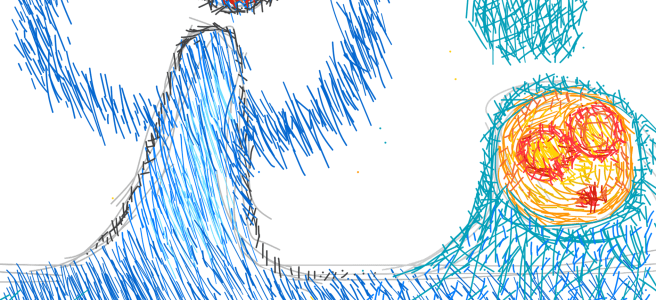
But the magic happens. With the blessing of the “muse,” we roll into another region of the mind. The turbid, whirling mass behind the wall of conscious and conscientious manners, of deliberate and logical thinking, becomes accessible. It’s quite extraordinary. Powerful. And, it is the bringer of fervent artistic creation along with its accompanying devils: doubt, fear, self-abuse. We must deal with these in the aftermath. In the tempest, however, is the ecstasy Nabokov refers to where what had seemed impossible becomes more than that…it becomes inevitable. The universe of a novel or painting or album pulls together of its own volition, because the mass and inertia is too large for one person to do it deliberately. But somehow it happens–the universe briefly organizes, the impossible has become inevitable–and only because the artist has become the medium for that volition.
Afterwards…we beg off for awhile, collect ourselves, and begin again the process of inviting the muse.
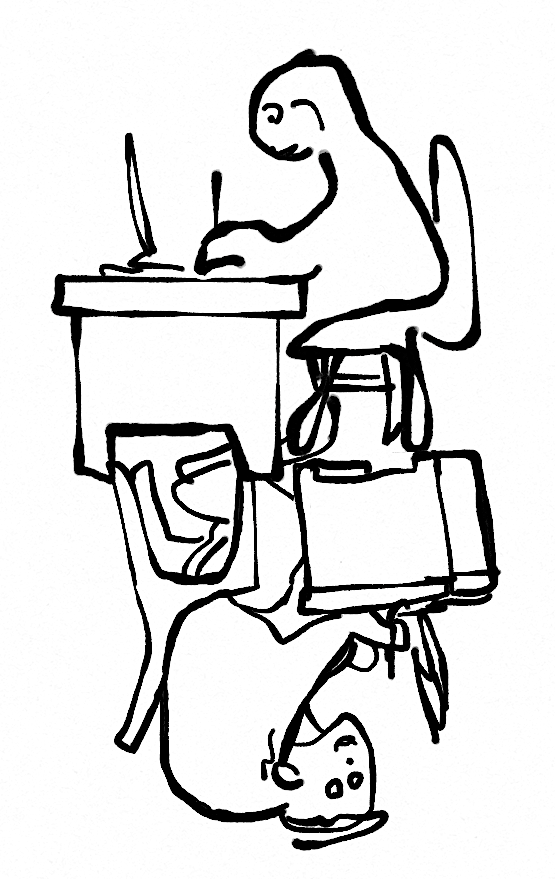
 Our publication’s newest reader. And we’re thankful to the parent of this greatness-in-the-making for sharing such a candid moment!
 The Almagre Review