PURCHASE


Growing up in south Texas in the 50’s we used to get Christmas presents on three different days. First there was the feast of Saint Nicholas on December 6. Saint Nicholas, a fourth-century bishop who gave gifts to poor people, is the original gift-giver whose name has morphed from the Dutch Sinter Klaas into Santa Claus. Because of him people in Europe give and receive gifts. A remnant Spanish custom survived in our small town and the children got gifts on December 6. I remember getting oranges and apples in my stocking, but never the proverbial lump of coal that the bad kids were supposed to get. For many of the older Mexican people Dec. 6 embodied the spirit of the season, whereas Christmas was the American celebration. All the Christmas customs, the gift-giving, the decorations, etc. were absent. We didn’t have a Christmas tree, for instance, until sometime in the late 50’s. My mother found a dried branch from the huge pecan tree in the yard. She brought it inside the house, painted it white and hung Christmas lights on it. That was the first Christmas tree I remember. It looked beautiful. Gradually, Christmas presents began to appear under the tree. By the early 60’s most of the old customs had died out and the new Christmas had taken over.

The real celebration of “Christ’s Mass” was at church. “Misa de Gallo,” midnight mass on Christmas Eve was the important occasion and even the little kids would attend. The highlight was the procession of the children to the empty manger, to lay down the image of Baby Jesus. After mass everyone would go home and eat tamales and drink the powerful cinnamon-laced Mexican chocolate. That stuff could keep you up all night but of course that was not allowed for the children. The men had gone deer hunting and brought back plenty of venison. The women had spent hours in the kitchen marinating the meat and putting it into the corn dough wrapped in corn husks and then steaming the tamales in huge pots. There is nothing more delicious than venison tamales. For days afterward we would be eating tamales. At Christmas women ruled the house. I remember my mother and her “comadres,” which literally means “co-mothers,” making untold dozens of tamales and enjoying their sisterhood time. I sneaked in just to listen to them talk, but men were not allowed in the kitchen.
The twelve days of Christmas, December.25-January 6, had real meaning in those times. There was the joy of Christmas, but mixed with sadness, as all earthly experience must be. We remembered the Holy Innocents on Dec. 28, when all the men and boys named Inocente were honored. I often wondered how so many not-so innocent types could have that name. And how could Herod have killed so many babies? There was New Year’s Day, sacred to God the Father, who seldom gets any credit, but because of him sacred to all who bear his name, Manuel. After that there was Epiphany, on January 6, holy to all those named Epifanio. On Epiphany the Magi come bearing rich gifts. It is the Day of the Three Kings, el Dia de los Reyes Magos, the day of the Wise Men. This is also the name-day of all those named “Reyes.” In the old way of looking at things your name-day is much more significant than your birthday. The saint or sacred feast whose name you bear is your protector, a type of totem beloved in the Indo-Hispano culture.
If there was a true joyous day for all, this was it. Jan. 6 definitely eclipsed Christmas for gift-giving. Baltazar, Melchor, and Gaspar had brought gold, frankincense and myrrh to the Christ Child. We emulated them and brought our own gifts. We gave gifts to friends and family. But in a holy time it’s the King you must honor and how can you give the King any gifts? He already has everything, owns everything. He doesn’t need your poor gift. The Irish nuns at the parish school told us so. They said that on his birthday it is the King who gives gifts. During this season we should ask the King for a favor. There is always life, but also death, and the Irish, like the Mexicans, are ever aware of death. The grace we should request, the sisters said, was for the dead–the release of dear loved ones from Purgatory. Release of captives, that was the true spirit of Christmas and Epiphany. More purified sinners are released from Purgatory at Christmas than on All Soul’s Day.
Joe Barrera, Ph.D, is the former director of the Ethnic Studies Program at UCCS, and a combat veteran of the Vietnam War.
The season of death and dying is here. Autumn brings the end of the year, the end of living things, the end of growth in the cold of winter. October 31, All Hallows’ Eve, Halloween, albeit much altered from its original intent, is a celebration of the end of the harvest but also a recognition of the presence of the dead on earth. Originally, Halloween was the time when ghosts of the dead, along with unholy spirits, were given free rein to roam the earth before they were again confined in Purgatory or in Hell. They had to be confined in anticipation of November 1, the Day of All Hallows, the Holy Ones, the saints in heaven. All Saints is followed by All Souls on November 2, during which we honor the Souls in Purgatory, suffering purification before entry to heaven in the Catholic belief that was once universal in Europe. The season is the last vestige in modern culture of the reality that life and death are two sides of the same coin, that where there is life there must also be death, that the same Creator who created life also created death. The season tells us that we should not ignore death, nor fear it, because it is part of our existence and we cannot avoid it. In our culture, which deludes us into believing that youth and physical beauty are eternal, we don’t pay much heed to this kind of thing anymore.
Our Halloween customs derive from northern Europe, but traditions known as The Days of the Dead, usually the last days of October and first days of November, have come in from lands to the south. These influences are often mistakenly considered to be “Mexican Halloween,” but Halloween and The Days of the Dead are very different celebrations. In Mexico, death is traditionally honored in a much more open fashion than it is here. Death is held in high esteem, in a reverential sense, not in the spooky, haunted sense of Halloween.
Awareness of the dead is typical of a culture that looks to the past, as in Mexico, not of a future-oriented culture as in the U.S. In Mexico, which is strongly mindful of the past, the amalgamation of Iberian Catholicism, full of ancient Greek and Roman roots, with the indigenous religions of the Aztecs, has given rise to a rich tradition known as los Dias de los Muertos, or The Days of the Dead. We enjoy the celebration here in spite of the cultural differences. A manifestation of this in U.S. culture is the creation of “altares,” altars in remembrance of deceased friends or relatives. These are commonly found in art galleries, where they are seen as opportunities for artistic license. In Mexico, altars to the dead are found in many homes. They are sincere tributes to loved ones, not art installations. Portraits of the departed are displayed, and their favorite food, drink, cigarettes, personal items, etc. are laid out in anticipation of their earthly visitations. The intent is to honor the deceased out of love and affection but also from a profound sense of the very thin veil that separates this life from the other life. In some ways, The Days of the Dead resemble American Memorial Day. Families in Mexico go to cemeteries to visit and adorn the tombs and to share meals with the dead. This is something which we should respect.
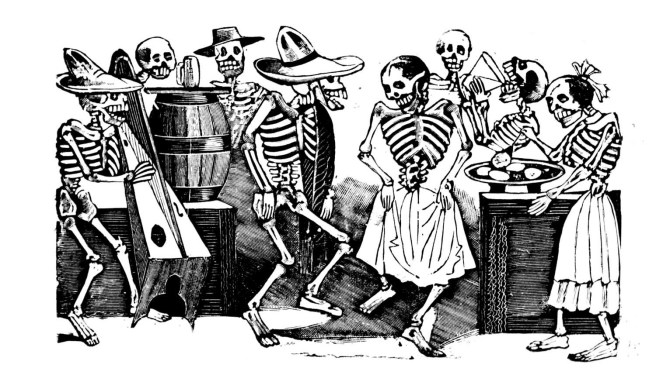
The veil separating life and death is indeed flimsy. We must realize that we will all soon be dead. What happens then? The Mexican artist, Jose Guadalupe Posada, is famous for his depictions of skeletons behaving as if they were still alive, enjoying all the pleasures of human life–food, drink, fancy clothes, parties, dancing, even sex. Posada’s skulls and bones in the midst of carnal pleasures symbolize the union of life and death. They also warn us of the illusory nature of pleasure. His art has been appropriated by the dominant U.S. culture and is now found everywhere. But his ideas have not. We see the dancing, drunken, fornicating skeletons as just funny art, missing the point of the illusion of human existence and the much more real intimacy of life and death.
The Days of the Dead celebration in U.S. culture is an example of cultural blending, something which always happens when distinct cultures rub against each other, as is the case in this part of the country. This can be good because cross-fertilization like this saves U.S. culture from stagnation. It goes the other way, too. Mexican culture is influenced by American culture. However, the popularity of The Days of the Dead is an appropriation by the American dominant culture of an element from the subordinate Mexican culture. As such, the meaning of the celebration has been altered. Things get changed when cultural elements are removed from their original context. They diverge from their original meanings. They may be trivialized, stripped of serious meaning, made into “kitsch,” becoming pretentious, shallow and gaudy. This is what has happened to The Days of the Dead in the U.S. The sacred meaning of Los Dias de los Muertos has been lost. This sacredness can be understood to be an escape from human rationalism, a journey into a space of intense, passionate, personal religion, a religion not about obeying God but more about one’s relationship with the physical world and simultaneously with the spiritual world. This is a religion of beauty, and definitely not one of fear of death and punishment for sins, but one of love in a space where loved ones await living human beings, who are the soon-to-be dead.
Joe Barrera, Ph.D., is the former director of the Ethnic Studies Program at UCCS, and a combat veteran of the Vietnam War.

Here at the Almagre, we are thrilled about our upcoming issue (Publication in JUNE). This will be a great opportunity for Colorado readers and writers to experience fantastic local talent alongside voices from all over (and we do mean all over!). There is, of course, the interview with famed Southwest writer, John Nichols, sharing insight about his environmental philosophy and the ways it manifests in his writing.
But this issue will feature much, much more. Readers will find contributors from all over the country whose work has appeared in other prestigious publications such as the Massachusetts Review, TriQuarterly, Asimov’s Science Fiction, The Sun, and others. We have words penned by some of Colorado Springs’ finest talent as well as beautiful poems from as far away as India and the Netherlands.
These are exciting times for Colorado Springs’ newest literary journal, and we’re asking those who are passionate about art and narrative to come join us. Spread the word to friends, to family, to fellow authors and artists. Absolutely everything we make from this passion-project pours back into the pages which carry the magic of the written word. Come help us tell the story of America.
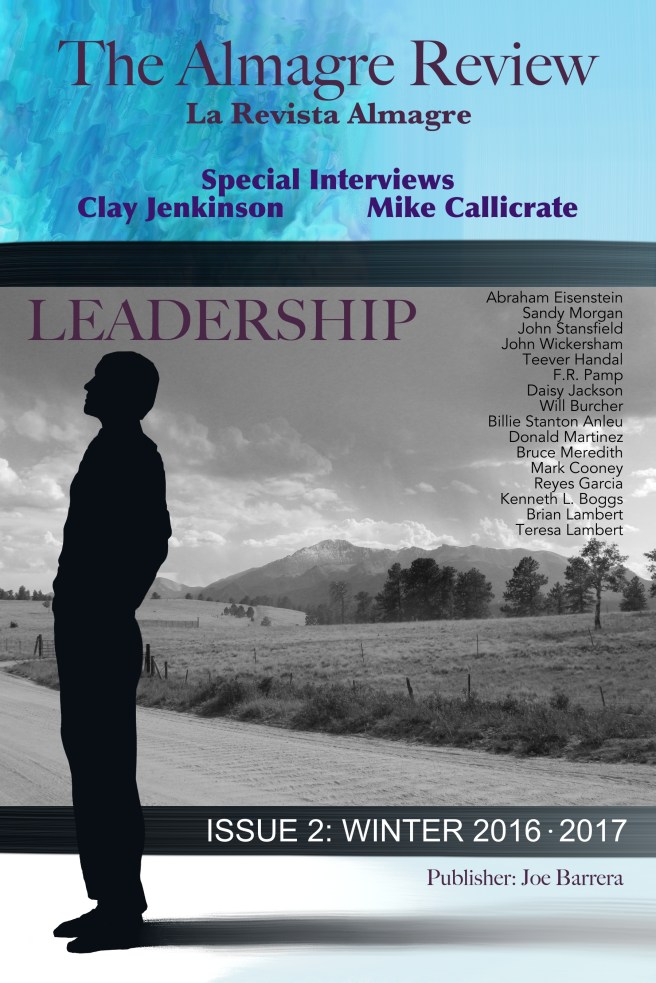
The Almagre Review/La Revista Almagre is excited to share the publication of our second issue. We have wonderful local contributors, writers from up and down the front range, from the prairie, all the way to Wisconsin. To purchase a copy online, click HERE ($12 plus shipping). Copies are also available at the downtown locations of Hooked On Books and Poor Richards.
The Almagre Review will be at the Manitou Art Center on December 16th for their art opening. Copies of issues one and two will be available for purchase. Stay tuned for additional dates and events.
Warm Regards,
The Almagre Staff
Yes, in the spirit of leadership, the theme of issue two, we’d like to honor bookstores and especially their proprietors.
The Almagre Review wants to take a minute to thank Hooked On Books for their enduring dedication to Colorado Springs’s local authors. One might not realize this, but Jim and Mary Ciletti devote a tremendous amount of time and resource to writers who publish and sell their work locally.
The bookstore, we all know, is a diminished institution. This is not because we read less than we used to; that is a misconception. We read more than ever. But, we read differently. Deep attention to long, rich works grows scarcer by the year. We collect information like grains of sand blowing through the air. News by captions! This is the age of trying to form complex world-views out of a chaotic constellation of information. Our contemporary consumption of the written word has conferred all its disadvantages upon the local bookstore.
Companies like Barnes and Noble can manage, but even then, not all the large companies survive–Borders went out of business. And for the mom and pops bookstore? To find one is a treasure, to support them–a public service. There’s a touch of the heroic, born of faithful dedication, to Jim and Mary Ciletti for their labors in sustaining a brick and mortar location for story enthusiasts like us.
As a gesture of friendship, take the time to stop by Hooked On Books, or any bookstore. The Almagre recommends this from a place of deep gratitude. While there, let Mary or Jim know, that it was at the urging of Colorado’s newest literary journal. Most importantly, ask the proprietor, “what book by a local author do you suggest today?”


Joe and I would like extend our thanks and gratitude to the men and women who have defended our country.
I have been privileged to share in this venture, our humble publication, with Joe, who served in Vietnam. I think of him as a dear, and unlikely friend, for the fact that we came together over this project from different backgrounds and different generations. It has been an honor to hear some of his stories, and to be exposed to new insights and thoughts that only a veteran can share. I think of Joe as part of the family… and he has joined my family at the dinner table many times.
When we set out to build The Almagre Review, one of the things we wrote into the ethos of our journal is that, “we consider ourselves a friendly home to veterans.”
There are publications out there which are dedicated to soldiers and their tales. There are also mainstream literary journals, and one will occasionally encounter soldiers’ tales in them. At our journal, we’d like to somewhat dissolve those borders, and be a publication for the mainstream public where one commonly finds words penned by America’s military women and men.
And… about those dinners with Joe. Certainly, we talk about literature, about politics, about art. We talk about our journal, our writing. But mostly, he sees to it to talk about my family, the kids, my wife, and to remind me how special they are. This is where we always end up. And it’s the least I can do for him… share a place at the table, with my family, for whom he feels great affection.
It’s an honor, that we at The Almagre Review, can offer our pages to veterans as if it is the family dinner table. We welcome writers of all backgrounds, but we pay particular attention to the words of those who have served.
Again, a profound thank you to our veterans
~The Almagre Staff
 Our publication’s newest reader. And we’re thankful to the parent of this greatness-in-the-making for sharing such a candid moment!
Writers ask a lot of their readers. It’s more than just time. The solicitation is quite intimate, begging more of a total investment.
We can’t speak for everyone, but here at our humble publication, we know how slippery and temporary ideas are…all ideas, great ones especially. Once committed to paper, an idea finds a quasi-permanence.
So in the age where most stories are told through moving images and sound, the written word in all its static glory must rely on its most powerful quality. That quality is this intimacy…the theater of another’s mind. Here, a poem or novel moves in, like a circus, it sets up camp, unfolds its tents, un-carriages the animals, and builds a show between the ears of another human. Think of this invitation, this opportunity to inhabit each other. It’s a unique dialogue. When the reader shares his time with all those set pieces stored in the attic of his imagination, those wares built from the thread of experience, he gives the writer her reason to be. He also gives her the stage for her ideas. The necessary loop is complete and the current can flow.
We all remember that thing the last exquisite novel provided which a movie cannot produce. The scenes and scents and people moved through our head. We were not passengers, we were not emotional patients strapped to the operating table. We were part of the story. In some ways, it was even about us.
Thank you to our readers who have taken the time to be a part of our journey. We look forward to the big sky horizon of the West and all the future stories waiting to fill our pages.
~John Lewis,
Artist/Editor

 The Almagre Review