Joe Barrera: Remembering the Mini-Tet Offensive

MVCD Button

Memorial Day is about memories. With this in mind, I visited Joe Berg, the director of the 4th Infantry Division Museum at Fort Carson. There is a soft spot in my heart for the 1st Battalion, 8th Infantry, 4th Division, with whom I served in Vietnam. I asked Joe about Mini-Tet and the 4th Division. The North Vietnamese and Viet Cong Tet Offensive, Phase One, of January and February 1968, is well-known. Not so the Tet Offensive, Phase Two, in May 1968. We called Phase Two Mini-Tet, because it had all the ferocity of Big Tet. The 4th Infantry Division whose Area of Operations (AO) was the Central Highlands of South Vietnam, was particularly hard hit. In late May 1968 I was with 1/8th Infantry in the mountainous tri-border area of Laos, Cambodia and Vietnam. I asked Joe Berg what the historical record says about 1/8th Infantry and the 4th Division in the battles we fought there.

I knew the answer already but I wanted confirmation. The record is very skimpy. The 4th Division is a good outfit. In WWI, the division distinguished itself during the Meuse-Argonne Offensive, Pershing’s sledgehammer attacks on the Hindenburg Line. In WWII, the 8th Regiment, my old unit, spearheaded the 4th Division’s D-Day landings and was the first to secure its beach head, Utah Beach. But in Vietnam we never got the credit we deserved. The battle cry of the division is “Steadfast and Loyal,” and that it has always been. But in the Nam it was other units–the 1st Cavalry, the 173rd Airborne, the Marines at Khe Sanh–who got all the attention. Joe Berg showed me Erik B. Villard’s book, Staying the Course: October 1967 to September 1968–the U.S. Army in Vietnam. Villard devotes about two pages to the 4th Division’s battles in the tri-border area. There is a brief mention of 1/8th Infantry’s fight with the North Vietnamese (NVA) 95C and 101D regiments at Firebase 29 on Hill 824 and other nearby firebases near the Montagnard village of Ben Het. Villard has a lot of ground to cover, so the brevity is understandable. But I wish it wasn’t so.

I was on one of those hilltop firebases whose name I do not remember. At first we were glad to be on the firebase, relieved from humping the 75lb rucksacks we carried. But that didn’t last long.The enemy kept up a constant mortar and artillery barrage. Day and night mortar rounds fell like rain. We were a shooting gallery for 75mm recoilless rifles from adjacent hilltops. Then the two-week-long barrage by Russian-supplied 152mm NVA artillery out of Laos just five clicks (kilometers) away. Those were big rounds, coming in with a horrible shriek. The NVA gunners aimed for the U.S. artillery batteries on the hilltop. We lived like moles in trenches and deep bunkers. We couldn’t patrol outside the wire. They had us surrounded and to venture out was to risk a deadly ambush. Resupply helicopters came in at their own peril. We suffered like the Marines besieged at Khe Sanh. Not as long, but the same kind of thing.

The spirit words on the 8th Regiment’s coat-of-arms are Patriae Fidelitas–Faithfulness to Country. I ran by the  tactical operations center, the TOC, one night and tripped on something. It was the battalion placard, blown down by one of those huge 152 artillery rounds. In the glare of an explosion I saw the Latin, Patriae Fidelitas. The sentiment is powerful. Roman soldiers on Hadrian’s Wall, guarding the empire’s remotest frontier, must have felt it too. Now the 8th Infantry held a 20th-century frontier. I propped up the sign against the sandbags and ran to the safety of my own deep bunker.


Joe Barrera, Ph.D., is the former director of the Ethnic Studies Program at UCCS, and a combat veteran of the Vietnam War.
Joe Barrera: History of the Southwest Needs Revision

I often wonder why U.S. schools ignore so much that is important when teaching history. It’s a strange thing for a patriotic people, but much of mainstream history is unknown, leaving students ignorant of the foundations of the country. “Minority” history, of course, is almost a complete blank. The Southwest, in particular, is ignored. I tell anybody who will listen that history is important, but as a young man once said to me, “I don’t need to know that because it happened before I was born.” In my eternal quest for enlightenment, I was in Taos last week at the annual international meeting of the Anza Society, a group devoted to research and education on the life and times of Juan Bautista de Anza, the Spanish governor of New Mexico, 1777-1787, and intrepid trailblazer who explored much of what is now the U.S. Southwest.

Juan Bautista de Anza jpeg
Juan Bautista de Anza

Anza’s main claim to fame is the campaign against the Comanche Indians, led by a chief named Cuerno Verde, who wore a buffalo headdress with green-painted horns, hence the name, Greenhorn. In 1779, Anza led a large force of Pueblo, Ute, and Apache Indians, along with presidial troops and New Mexican settlers, down Ute Pass through what is now Manitou Springs and Colorado Springs. This was a trail-blazing feat which is only poorly known. Known or not, the  Spanish and Indian presence here makes me feel good. I am happy that our patch of ground was the site of events important in the history of the region. The war against the Comanches is important because it shows Anza’s genius, his ability to organize an allied expedition of Native Americans, Spanish soldiers and mestizo settlers against the destructive Comanches who were raiding in New Mexico, indiscriminately attacking indigenous people and settlers. Anza took the Comanches camped along Fountain Creek by surprise, ultimately defeating and killing Cuerno Verde near what is now Walsenburg. This victory and other battles resulted in the Anza-negotiated Comanche Peace of 1786, saving the remote colony of New Mexico from likely destruction by the fierce Comanches. This puts Anza in the same league with famous American frontiersmen, people like Daniel Boone, Kit Carson, John C. Fremont, and Lewis and Clark. Yet we never hear about him. Fortunately, a group of dedicated community leaders are planning a Colorado Springs Anza Memorial at the confluence of Monument and Fountain Creeks, possible site of the first skirmish with the Comanches as Anza descended Ute Pass.

Sometimes history can play tricks on you. I was with the Anza conference attendees when we toured Taos Pueblo. On the edge of the adobe apartments of the thousand-year-old Taos Pueblo are the ruins of the church of San Geronimo, destroyed by Colonel Sterling Price’s 2nd Regiment of Missouri Mounted Volunteers and Captain John Burgwin’s 1st U.S. Dragoons in February, 1847. The New Mexican and Taos Indian insurgents had revolted against the American occupation, killed the governor imposed on them by the U.S. Army, and were now holed up in the church. I gazed at the wooden crosses in the campo santo, the church-yard cemetery, the mounds of decomposing adobe bricks, and the bell tower that still stands, repaired just enough by the Taos people to keep alive the memory of their slain compatriots. Then I saw the dragoon captain rally his troops for a charge. He was out in front. He fell, mortally wounded. At that moment I felt that I was fated to see what once was, was not now, invisible, but yet still visible. It was real to me. I suppose the experience just came from the knowledge of history.

Joe Barrera, Ph.D., is the former director of the Ethnic Studies Program at UCCS, and a combat veteran of the Vietnam War.

Joe Barrera: The Real Meaning of Cinco de Mayo

Once upon a time there was an emperor who wanted to make his country great again. He thought, “if we conquer more lands we will become even more feared and respected. If we send the army on an extended deployment we will find the military glory we have always wanted.” Thinking like this, the emperor knew that he had to find a country that would be ripe for the taking. Trouble was, all the neighboring empires were too strong to attack. The emperor didn’t like it, but he was compelled to look far away for a weak country to conquer. Try as he might he could not find one. Then he had a stroke of luck, or so he thought. It turned out that there were some wealthy people who had been driven out of their own country by a revolution and were now living in the capital city. They decided that they had the answer to the emperor’s problem.

The exiles went to see the emperor, who at first received them with some skepticism, but then became quickly interested in the scheme they proposed. “The man who is now president in our country,” they said, “is very unpopular and could be easily overthrown by the army of Your Imperial Highness. Not only is he unpopular, he is also a radical socialist who has confiscated our estates and left us destitute. He deludes the masses by pretending to liberate them from the tyranny of the rich.” The emperor heard this and felt a twinge of conscience. He knew that many of his own subjects were chafing under the oppressive social order he was enforcing. But not to worry. He felt very secure in his power. The oily exiles continued with their blandishments. “Your Highness could appoint your nephew, the Archduke Maximilian, to be the king of our country. He is a man who is ready to serve you and is just looking for an endeavor worthy of your greatness. The people will welcome him with open arms. They will throw flowers at your soldiers when they invade our country. The people will embrace your enlightened rule and all the benefits it will bring.”

The emperor believed them. He sent his army with the Archduke at its head across the sea. But the promises of the exiles were a pack of lies. The president was not unpopular. The people did not welcome the foreign soldiers with bouquets of flowers. They resisted the invaders and mounted an insurgency that lasted for years. The president led the guerrilla war and was never caught in spite of many defeats by the superior forces of the empire. Finally, the emperor gave up. He recalled his army and as soon as the soldiers left the Archduke was shot by the insurgents. The emperor who had dreamed of glory was himself soon deposed when another stronger empire invaded his country.

Sounds familiar, doesn’t it? With a few minor changes this could be the story of our involvement in Iraq and Afghanistan. In this sense it is a cautionary tale for the United States. But this is the story of Mexico and France, and el Cinco de Mayo. Emperor Napoleon III, nephew of the first Napoleon, had delusions of grandeur. These were shattered at the Battle of Puebla, May 5, 1862, when a rag-tag Mexican army defeated the vaunted French. The battle started a war that lasted until the French were driven out Mexico. This flagrant European colonialism–the attempt to make brown-skinned people subject to white-skinned people–has become a lesson that teaches freedom. But we don’t know this. Instead, we have American el Cinco de Mayo, time for parties, time for Latinos and Anglos to get gloriously drunk and make the beer companies rich. If only we knew its original significance. The real meaning of this holiday is that we need to “decolonize” our minds. To “decolonize” means that we throw off the mental shackles of inferiority. For U.S. Chicanos, inferiority is always a problem. This is because we are always fighting inferiority, something that is more real internally than it is real externally. Mexican Americans can look at Black Lives Matter and at the Me Too Movement for inspiration. These are examples of human beings reclaiming their own inherent self-worth.

Joe Barrera, Ph.D., is the former director of the Ethnic Studies Program at UCCS and a combat veteran of the Vietnam War.

Joe Barrera: Reflections on the 50th Anniversary of the Tet Offensive

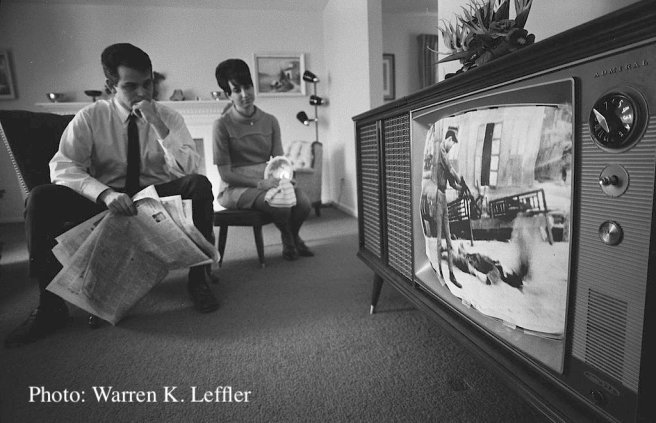
On Feb. 3, 1968 I was sitting on the banks of a muddy river in the village of Thanh Canh, or as we called it, Tin Can. I never learned the name of the stream. Reflecting on that time, Tet 1968, I see a microcosm of our misadventure in Vietnam. The situation revealed lessons we should have learned but did not.

Tet Offensive (Warren K Leffler)

Convoys of U.S. and South Vietnamese jeeps, APCs (armored personnel carriers), trucks loaded with troops, M-48 tanks, dusters (armored vehicles with 40mm cannons) crossed the river on a pontoon bridge. The convoys looked powerful but it was an illusion. On one side of the bridge there was a French fort, an enclosure surrounded by berms, mounds of dirt. The defenders burrowed into the mounds to make fighting positions. We called it the “mud fort” because it was just a triangle of muddy dirt, a relic of the French Army’s futile attempt to control Annam. The fort was a harbinger for us. Along the river, bamboo hooches (shacks) stretched for several kilometers. The fort was manned by the Regional Forces/Popular Forces, RF/PFs, trained by U.S. Green Berets, part of our futile effort to control Vietnam. We called them “Ruff Puffs.” They hid in the fort at this crossing on the road between Kon Tum and Dak To and never came out. We were out all the time. We walked up to the French mission. There were dozens of kids, Vietnamese nuns, an exquisite Catholic church, an ascetic French priest–the lone survivor. The mission, the church, the mud fort. I doubt that anything is there anymore. Shades of Beau Geste and the Foreign Legion.

A horde of villagers came running downstream and into the ramshackle fort. The North Vietnamese were advancing. They were a short distance away. Immediately, the U.S. tanks patrolling the road formed a defensive lager next to the fort. We infantrymen had to content ourselves with holes along the banks. But all was quiet. That night one of the tankers fired H&I (harassment and interdiction) up and down the river with his M79 grenade launcher, which fires a 40mm projectile. In the morning the Ruff Puffs yelled and shook their fists at the tanks. The H&I had sunk numerous sampans, boats the villagers used to fish in the river. There went their livelihood. So much for winning hearts and minds.

In the afternoon loin-clothed Montagnards filed into our perimeter. Their leader, a dignified old man, sat down with us. I gave him a can of Coca-Cola. He drew a map in the dirt. We compared our map to his. The others were disdainful but I insisted that he was telling us something: a concentration of NVA troops. I read the coordinates and convinced one of the tankers to use his powerful tank radio to call in an air strike. The jets came in. That took care of the imminent threat. The Montagnards melted into the forest. Did they escape reprisals from the North Vietnamese?

We won every battle in Vietnam, including Tet, but lost the war. There are reasons why we lost in Vietnam and are bogged down in our present wars: We have good motives but our empire treads the path of older empires. We do not effectively engage the enemy. We are too road-bound, too inflexible. We build too many “mud forts.” We do not understand local cultures and alienate our friends. We dismiss nationalism, the impulse to throw out the foreign invader and recover past glories. Nationalism inspired by religion is what motivates our present enemies. It’s almost impossible to stamp out, and now it has terrible forms–the Taliban and the horribly twisted ISIS.


Joe Barrera, Ph.D., is the former director of the Ethnic Studies Program at UCCS, and a combat veteran of the Vietnam War.
Joe Barrera: Christmas in South Texas

Growing up in south Texas in the 50’s we used to get Christmas presents on three different days. First there was the feast of Saint Nicholas on December 6. Saint Nicholas, a fourth-century bishop who gave gifts to poor people, is the original gift-giver whose name has morphed from the Dutch Sinter Klaas into Santa Claus. Because of him people in Europe give and receive gifts. A remnant Spanish custom survived in our small town and the children got gifts on December 6. I remember getting oranges and apples in my stocking, but never the proverbial lump of coal that the  bad kids were supposed to get. For many of the older Mexican people Dec. 6 embodied the spirit of the season, whereas Christmas was the American celebration. All the Christmas customs, the gift-giving, the decorations, etc. were absent. We didn’t have a Christmas tree, for instance, until sometime in the late 50’s. My mother found a dried branch  from the huge pecan tree in the yard. She brought it inside the house, painted it white and hung Christmas lights on it. That was the first Christmas tree I remember. It looked beautiful. Gradually, Christmas presents began to appear under the tree. By the early 60’s most of the old customs had died out and the new Christmas had taken over.

Nativity

The real celebration of “Christ’s Mass” was at church. “Misa de Gallo,” midnight mass on Christmas Eve was the important occasion and even the little kids would attend. The highlight was the procession of the children to the empty manger, to lay down the image of Baby Jesus. After mass everyone would go home and eat tamales and drink the powerful cinnamon-laced Mexican chocolate. That stuff could keep you up all night but of course that was not allowed for the children. The men had gone deer hunting and brought back plenty of venison. The women had spent hours in the kitchen marinating the meat and putting it into the corn dough wrapped in corn husks and then steaming the tamales in huge pots. There is nothing more delicious than venison tamales. For days afterward we would be eating tamales. At Christmas women ruled the house. I remember my mother and her “comadres,” which literally means “co-mothers,” making untold dozens of tamales and enjoying their sisterhood time. I sneaked in just to listen to them talk, but men were not allowed in the kitchen.

The twelve days of Christmas, December.25-January 6, had real meaning in those times. There was the joy of Christmas, but mixed with sadness, as all earthly experience must be. We remembered the Holy Innocents on Dec. 28, when all the men and boys named Inocente were honored. I often wondered how so many not-so innocent types could have that name. And how could Herod have killed so many babies? There was New Year’s Day, sacred to God the Father, who seldom gets any credit, but because of him sacred to all who bear his name, Manuel. After that there was Epiphany, on January 6, holy to all those named Epifanio. On Epiphany the Magi come bearing rich gifts. It is the Day of the Three Kings, el Dia de los Reyes Magos, the day of the Wise Men. This is also the name-day of all those named “Reyes.” In the old way of looking at things your name-day is much more significant than your birthday. The saint or sacred feast whose name you bear is your protector, a type of totem beloved in the Indo-Hispano culture.

If there was a true joyous day for all, this was it. Jan. 6 definitely eclipsed Christmas for gift-giving. Baltazar, Melchor, and Gaspar had brought gold, frankincense and myrrh to the Christ Child. We emulated them and brought our own gifts. We gave gifts to friends and family.  But in a holy time it’s the King you must honor and how can you give the King any gifts? He already has everything, owns everything. He doesn’t need your poor gift. The Irish nuns at the parish school told us so. They said that on his birthday it is the King who gives gifts. During this season we should ask the King for a favor. There is always life, but also death, and the Irish, like the Mexicans, are ever aware of death. The grace we should request, the sisters said, was for the dead–the release of dear loved ones from Purgatory. Release of captives, that was the true spirit of Christmas and Epiphany. More purified sinners are released from Purgatory at Christmas than on All Soul’s Day.

Joe Barrera, Ph.D, is the former director of the Ethnic Studies Program at UCCS, and a combat veteran of the Vietnam War.

Joe Barrera: On Veterans’ Day: A Tribute to the Valiant

MVCD Button

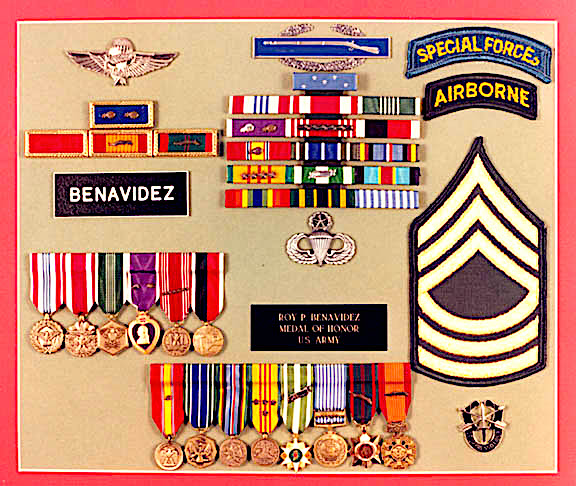
The ethnic group who won the largest number of Medals of Honor per capita in World War II was the Mexican/Chicano group. This trend continued in subsequent wars. Our city has a connection to a Medal of Honor winner.  He was in the Army Special Forces, the Green Berets, famously promoted by the assassinated John F. Kennedy, whose words, “My fellow Americans, ask not what your country can do for you–ask what you can do for your country” have power still.  In the years after Kennedy, the Green Berets were the Americans who asked, “What can we do for our country?” The soldier knew the answer to that question and acted on it. Now there’s a park in Colorado Springs named for him. It’s in the southeast part of town, home to many of his Mexican, Chicano, Latino, Hispanic brethren. It’s been a while since I went there. Maybe it’s time to go back, time to visit Master Sergeant Roy P. Benavidez Park and remember a hero.

Benavidez medals

Roy Benavidez started life as the son of migrant farm workers in south Texas. Like so many other Mexican Americans he saw the Army as a way out of poverty. He found the American dream, and much more, in the Army. He paid a high price for it, overcoming anti-Mexican racism in Texas, but he was always proud to serve his country. During his first tour in Vietnam, he was severely wounded when he stepped on a land mine. He spent six months in the hospital recovering. Then it was back to Vietnam. On May 2, 1968, west of Loc Ninh, a Special Forces Recon unit was inserted into an area controlled by the North Vietnamese Army (NVA). They were soon surrounded by the NVA and taking casualties. Roy volunteered to help extract this unit. In an LZ overrun with the enemy, with burning helicopters and dead men all around, he was wounded thirty-seven times, was nearly KIA, but, incredibly, survived. For saving most of the Recon team he was awarded the Medal of Honor, but not until 1981.

It’s good to honor heroes, especially those who like Benavidez suffer rejection but go on to prove their love of country. It’s good to do it because white Americans need to recognize two things: 1) Hispanic valor, and, 2) that Chicanos/Latinos clearly understand the great worth of this country and the freedoms it affords. When I was a combat infantryman in Vietnam most of the Hispanics in my company were men with deep roots in this country, people like me, whose ancestors were in south Texas at least 100-years before the Anglo Americans arrived. But there were “illegal aliens,” too. These were men who had crossed the border illegally for the express purpose of fighting for the United States. They loved the United States. In the Vietnam days Army recruiters could get illegals into the Army, where the majority ended up in the infantry. I hope that those guys all became U.S. citizens, but if not, will they be deported? I’m thinking of the Colorado Springs Valenzuela brothers, two Vietnam veterans who were deported to Mexico.

I have written about my uncle, Reynaldo V. Zuniga, and his exploits with the 23rd Regiment, 2nd Infantry Division, during WWII. He was badly wounded during the siege of Brest and nearly died. I grew up hearing his war stories. He had a big influence on me. One of his Army friends, Jose M. Lopez, also was a big influence on me. Not that Jose Lopez told stories. He was a very quiet man. It was my uncle who would tell the stories about Jose, who probably killed more enemy than Audie Murphy, or at least as many. On December 17, 1944, near Krinkeldt, Belgium, Jose M. Lopez killed 132 Germans with his light .50 machinegun. His actions saved the 23rd Regiment from annihilation in the German onslaught known as the Battle of the Bulge and earned him the MOH.

There’s a street in Pueblo, the Latino city, named after Joe P. Martinez. Joe fought with the 7th Infantry Division in the Aleutians campaign, and won the Medal of Honor in that almost forgotten operation. On May 23, 1943 Joe was killed on the island of Attu, leading the 32nd Infantry Regiment up the Holtz-Chichagof Pass against the entrenched Japanese. Pueblo is rightly called the City of Heroes in honor of Joe Martinez and others like him.

This year marks the 100th birthday of the 4th Infantry Division. The 4th Division is based at Fort Carson and in telling the history of the Division the post historian wrote about the Famous Fourth’s 1944 battle in the Huertgen Forest. He mentioned Macario Garcia, a soldier with the 22nd Regiment, who won the MOH for destroying three machinegun nests and killing six Germans. That was one battle he fought, but there was another one which is never mentioned in the citations. When Macario came home to Sugarland, Texas after the war he went out one day dressed in the uniform of his country’s Army, wearing the big blue ribbon and the Medal of honor around his neck. He sat down to eat at a restaurant. The white owner didn’t serve Mexicans and threw him out. Macario performed home front heroics and slugged the man. White soldiers and sailors rallied to Macario’s defense and soon there was a full-fledged brawl. That battle has now been won, paid for with the same blood shed on the battlefields. And that’s why Latinos fight, to win the rights they deserve as first-class citizens.

Joe Barrera, Ph.D.,
Former director of the Ethnic Studies Program at UCCS,
and a combat veteran of the Vietnam War.

Joe Barrera: Veterans’ Day is about Creating Community

In 370BC a Greek Army ventured into Mesopotamia, lured into supporting a claimant to the throne by the promise of money and booty. How the Greeks managed to extricate themselves from a hopeless situation in what is now Iraq and Syria is the subject of the famous account, The Anabasis of Xenophon. “Anabasis” means “a journey out of.” The story is that Cyrus, the pretender to the throne of the Persian empire, is killed by his rival and the Greeks find that they have backed the wrong faction. This, of course, sounds familiar. We are now in the same position as Xenophon, the wise and courageous soldier who leads the Greeks out of the trap. But unlike Xenophon we have no exit strategy to free ourselves from the Iraqi and Syrian quagmire.

Halicarnassus (Anabasis)
Go to the Military Veterans’ Community Dialogues

No doubt about it. We are stuck in Mesopotamia, not to mention Afghanistan. In my opinion it happened because we misunderstood the desires of those countries to create communities according to their own rules. The same for our tragic misadventure in Vietnam. The task for us now is to extricate ourselves by rediscovering our own rules for community. I don’t want to make too much of the analogy but the lesson is clear. Xenophon’s Ten-Thousand fought and won their battles and survived the long journey out of the desert by the unity forged in comradeship. They were a small army, but they acted more like a community, a nation on the march through hostile territory.

Community is essential. This is true in both the military and civilian spheres. Armies imbued with comradeship, the military equivalent of community, win battles against much stronger foes. Civil societies succeed, but only if they are true communities. During this season, when we honor veterans and the society they have protected, it’s good to reflect on this. Philosophers have described community in many ways. It’s useful to read what they say, especially those who write about human communities from the experience of war. J. Glenn Gray, the eminent Colorado College philosopher, in his book The Warriors: Reflections on Men in Battle says this about the communal spirit, what he calls “love as concern:”

The characteristic mood that accompanies love as concern is neither deep joy nor unrestrained grief, so often typical of erotic love. Concerned love knows relief and it knows anxiety in its depths, but seldom does it put everything at stake on the preservation of this or that life or treasure. Its care is for the whole and not the part.

The essence of community is a love concerned with the whole. Concerned love leads to the building of community after the destruction of war. Fortunately for human beings, most soldiers are not made into habitual killers by war, even if they are soldiers who have killed. They are capable of living civilian lives after war. Gray, the WWII veteran, is correct about this, even if many veterans doubt it. Other writers have sought to define community. Sebastian Junger, who was an embedded journalist with the 173rd Airborne Brigade in the Korengal Valley of Afghanistan and made a documentary about the experience entitled “Restrepo,” defines “concerned love” in a different way, the way of male bonding. In

his book, Tribe: On Homecoming and Belonging, Junger discusses a type of love among soldiers. The men form the ultimate in male bonding, a brotherhood which only men in battle can form. Hardship, such as war, enables soldiers to transcend selfishness. Junger knows from first-hand experience that the bane of modern armies, PTSD, would not exist if soldiers preserved that brotherhood when they return to the civilian world. Unfortunately, combat veterans lose this protection all too quickly. This Veterans’ Day, we should provide veterans the chance to re-enact the communal love of their small units, which existed in our society before we lost our tribal identity.

A good example of communal love is The Warrior Storyfield in Longmont. A group of veterans and artists formed a “tribe,” a sculpture project that gives the unspoken experience of war a voice through the creation of huge iron statues of a dragon, representing homo furens, the ferocious warrior, and the phoenix, representing the resurrection of human love in the soldier when he comes home. Closer to home we have the Veterans Community Dialogues, to be held on November 7.

Joe Barrera, Ph.D, is the former director of the Ethnic Studies Program at UCCS and a combat veteran of the Vietnam War.


COLORADO MILITARY VETERANS’ COMMUNITY  DIALOGUES (NOV 7)


MVCD Button
Click for map to event.

Date: TUESDAY, NOVEMBER 7, 2017
Time: 10AM-4PM
Event: Healing Through Story-Telling: We talk of experiences in the war zones and about experiences coming home. (You can stay for as long or as short a time as you want. We provide lunch.)

THE WOUNDED WARRIOR PROJECT
1 SOUTH NEVADA
COLORADO SPRINGS, CO 80903

MVCD_Photo A

Veterans talk to other Veterans. Spouses, Families, Friends Join the Dialogue. Supportive Community Members Extend Welcome and Acceptance. We are looking for veterans and active-duty soldiers, their families and friends, and community people who want to help veterans in their re-adjustment.

Contact: Joe Barrera, combat veteran, Vietnam War:  jjbarr46@gmail.com

Joe Barrera: Los Dias de los Muertos/The Days of the Dead

jose posada dancing skeletons
Artist: Jose Guadalupe Posada

The season of death and dying is here. Autumn brings the end of the year, the end of living things, the end of growth in the cold of winter. October 31, All Hallows’ Eve, Halloween, albeit much altered from its original intent, is a celebration of the end of the harvest but also a recognition of the presence of the dead on earth. Originally, Halloween was the time when ghosts of the dead, along with unholy spirits, were given free rein to roam the earth before they were again confined in Purgatory or in Hell. They had to be confined in anticipation of November 1, the Day of All Hallows, the Holy Ones, the saints in heaven. All Saints is followed by All Souls on November 2, during which we honor the Souls in Purgatory, suffering purification before entry to heaven in the Catholic belief that was once universal in Europe. The season is the last vestige in modern culture of the reality that life and death are two sides of the same coin, that where there is life there must also be death, that the same Creator who created life also created death. The season tells us that we should not ignore death, nor fear it, because it is part of our existence and we cannot avoid it. In our culture, which deludes us into believing that youth and physical beauty are eternal, we don’t pay much heed to this kind of thing anymore.

Our Halloween customs derive from northern Europe, but traditions known as The Days of the Dead, usually the last days of October and first days of November, have come in from lands to the south. These influences are often mistakenly considered to be “Mexican Halloween,” but Halloween and The Days of the Dead are very different celebrations. In Mexico, death is traditionally honored in a much more open fashion than it is here. Death is held in high esteem, in a reverential sense, not in the spooky, haunted sense of Halloween.

Awareness of the dead is typical of a culture that looks to the past, as in Mexico, not of a future-oriented culture as in the U.S. In Mexico, which is strongly mindful of the past, the amalgamation of Iberian Catholicism, full of ancient Greek and Roman roots, with the indigenous religions of the Aztecs, has given rise to a rich tradition known as los Dias de los Muertos, or The Days of the Dead. We enjoy the celebration here in spite of the cultural differences. A manifestation of this in U.S. culture is the creation of “altares,” altars in remembrance of deceased friends or relatives. These are  commonly found in art galleries, where they are seen as opportunities for artistic license. In Mexico, altars to the dead are found in many homes. They are sincere tributes to loved ones, not art installations. Portraits of the departed are displayed, and their favorite food, drink, cigarettes, personal items, etc. are laid out in anticipation of their earthly visitations. The intent is to honor the deceased out of love and affection but also from a profound sense of the very thin veil that separates this life from the other life. In some ways, The Days of the Dead resemble American Memorial Day. Families in Mexico go to cemeteries to visit and adorn the tombs and to share meals with the dead. This is something which we should respect.

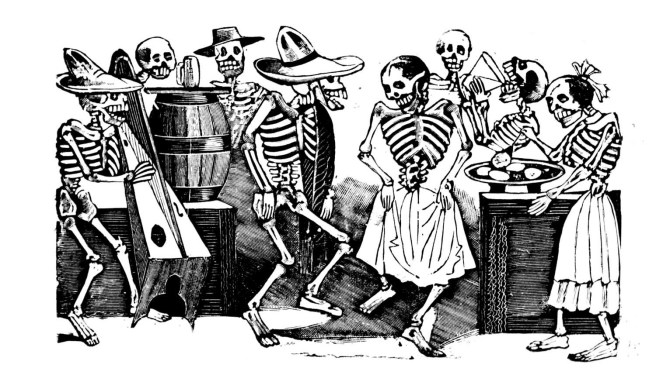
The veil separating life and death is indeed flimsy. We must realize that we will all soon be dead. What happens then? The Mexican artist, Jose Guadalupe Posada, is famous for his depictions of skeletons behaving as if they were still alive, enjoying all the pleasures of human life–food, drink, fancy clothes, parties, dancing, even sex. Posada’s skulls and bones in the midst of carnal pleasures symbolize the union of life and death. They also warn us of the illusory nature of pleasure. His art has been appropriated by the dominant U.S. culture and is now found everywhere. But his ideas have not. We see the dancing, drunken, fornicating skeletons as just funny art, missing the point of the illusion of human existence and the much more real intimacy of life and death.

The Days of the Dead celebration in U.S. culture is an example of cultural blending, something which always happens when distinct cultures rub against each other, as is the case in this part of the country. This can be good because cross-fertilization like this saves U.S. culture from stagnation. It goes the other way, too. Mexican culture is influenced by American culture. However, the popularity of The Days of the Dead is an appropriation by the American dominant culture of an element from the subordinate Mexican culture. As such, the meaning of the celebration has been altered. Things get changed when cultural elements are removed from their original context. They diverge from their original meanings. They may be  trivialized, stripped of serious meaning, made into “kitsch,” becoming pretentious, shallow and gaudy. This is what has happened to The Days of the Dead in the U.S. The sacred meaning of Los Dias de los Muertos has been lost.  This sacredness can be understood to be an escape from human rationalism, a journey into a space of intense, passionate, personal religion, a religion not about obeying God but more about one’s relationship with the physical world and simultaneously with the spiritual world. This is a religion of beauty, and definitely not one of fear of death and punishment for sins, but one of love in a space where loved ones await living human beings, who are the soon-to-be dead.

Joe Barrera, Ph.D., is the former director of the Ethnic Studies Program at UCCS, and a combat veteran of the Vietnam War.
business-card-monogram

Ken Burns’ “The Vietnam War”

MVCD Button
I have been watching The Vietnam War on PBS, the nation’s largest TV network. The program is billed as one of the best film documentaries about our misadventure in Southeast Asia. I agree that it’s a good one, but I have my reservations. It seems that I always find things that are wrong, or at least not accurate, about the Ken Burns effort and others like it. When I read books or news stories about Vietnam, watch old TV news clips, or see contemporary documentaries and movies, I cannot help but feel that we are not told the honest truth. Vietnam was never truthfully explained when Kennedy, Johnson and Nixon were in the White House. This is still the case even if the latest offering is good history, exposing the lies and miscalculations on the political and military levels that got us into Vietnam. The documentary does a good job of that. We see the duplicity of our government, the bloody tragedy that resulted and the bitter wounds of division, not yet healed, that the war and the betrayal by our government, caused at home. Many are now saying, “I didn’t know the history.” But I am concerned about other things.

I am a combat veteran of the Vietnam War. I did my duty as a soldier. But my experience puts me in a small category of Vietnam veterans. I did not want it, but I am numbered among the few who actually fought. This affects my vision. Once an infantryman, always an infantryman. This means that I am unforgiving when civilians attempt to explain my war. This is common among combat veterans. We love our wars. Yes, in our hearts we love them, for most of us an embarrassing secret, hard to explain. We are sensitive about this and sincerely try to tell our fellow citizens that we and our wars have been distorted by well-intentioned people. But it never seems to make a difference. Ken Burns and Lynn Novick do not understand my war and this love. In spite of their interviews with combat veterans, they manage to distort the Vietnam combat experience. Since this film started I have been telling people that it is distorted. All I get is doubtful looks and pitying stares.

Almost every U.S. veteran war story told in the documentary is a tragic one: Ambushes and human wave attacks. Platoons, companies, battalions overrun. Horrendous casualties. The story of innocent young men like Mogie Crocker, KIA in 1966, woven throughout the entire series, told by his mother and sister who can barely contain their grief fifty-one-years later. The starving POWs, reduced to killing and eating cats. John McCain, with two broken arms and a broken leg, tortured by his captors. The 7th Cavalry, decimated in the Ia Drang Valley. The 173rd Airborne Brigade and the arrogance of their commander, who let three companies suffer near annihilation on Hill 875. Only the Marine, Karl Marlantes, tells a heroic story of taking a hill and killing the North Vietnamese. But there was much glory for us, if you can accept that  there is glory in war. I wish the story of my battalion, 1/8th Infantry, 4th Infantry Division, had been told. In May of 1968 we fought and destroyed two regiments of NVA five klicks (kilometers) from the Laotian border during “Mini-Tet. What about the barrage of 152 millimeter Russian artillery that we endured for weeks during that battle? Now, there’s a story.

Losses happened. Many firefights ended inconclusively. The enemy was brave, just as brave or braver than we were. It was a war of attrition. But the fighting men never lost a battle. We lost the war, but that was no fault of ours. In their eagerness to tell the pathos of the war, accented by the maudlin lyrics and whine of Bob Dylan, Burns and Novick paint a picture of U.S. victims of the war. They make us out to be victims. It is true that the draftees didn’t want to be in “the Nam,” but the conscripts fought as bravely as soldiers in any other war. This is said by some of those interviewed but it is lost in the general narrative.

In contrast, the VC and NVA narratives ring with righteousness and heroism. Our men don’t smile for the camera. We see more than one stereotypical GI weeping veteran. The VC and NVA veterans look happy. Of course, they won, so they should look happy. U.S. film footage that Burns and Novick show is all real–we see bloodied American corpses. The North Vietnamese Army (NVA) footage is obviously Communist propaganda, staged scenes of the victorious People’s Army of Vietnam, the PAVN, as they called themselves. No dead NVA in their films. That is the first thing that seized me when I saw the first episode. I asked myself, “don’t Burns and Novick realize that they are showing Communist propaganda?” They interview an NVA cadre in his dress uniform. The man looks much too young to be a veteran of a war fifty-years ago. No Americans are interviewed in dress uniforms and they are all old men.

There is one more bone to pick. Burns and Novick almost completely ignore the presence of Hispanic soldiers. Only Everett Alvarez, the longest-held POW in Hanoi, is interviewed. If not for that dubious distinction I feel that Alvarez would not appear in the documentary. It’s a pattern. Burns was forced to add an episode about Hispanic soldiers to his WWII documentary after the American GI Forum, a Hispanic veterans’ organization, threatened a boycott in 2007. He had completely left out the role of 500,000 Hispanic soldiers in WWII.  Burns should take another look at the Vietnam Veterans Memorial in Washington. It is the only public monument in which Hispanic valor is faithfully honored. Thousands of Spanish names are engraved on that Wall, written and paid for in blood.

Joe Barrera,
Publisher
AR monogram K