Joe Barrera: Los Dias de los Muertos/The Days of the Dead

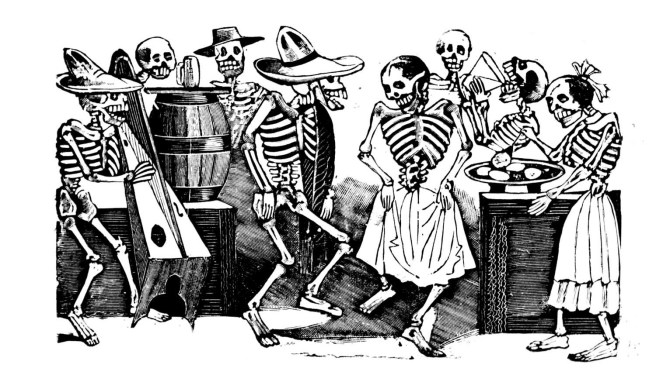
jose posada dancing skeletons
Artist: Jose Guadalupe Posada

The season of death and dying is here. Autumn brings the end of the year, the end of living things, the end of growth in the cold of winter. October 31, All Hallows’ Eve, Halloween, albeit much altered from its original intent, is a celebration of the end of the harvest but also a recognition of the presence of the dead on earth. Originally, Halloween was the time when ghosts of the dead, along with unholy spirits, were given free rein to roam the earth before they were again confined in Purgatory or in Hell. They had to be confined in anticipation of November 1, the Day of All Hallows, the Holy Ones, the saints in heaven. All Saints is followed by All Souls on November 2, during which we honor the Souls in Purgatory, suffering purification before entry to heaven in the Catholic belief that was once universal in Europe. The season is the last vestige in modern culture of the reality that life and death are two sides of the same coin, that where there is life there must also be death, that the same Creator who created life also created death. The season tells us that we should not ignore death, nor fear it, because it is part of our existence and we cannot avoid it. In our culture, which deludes us into believing that youth and physical beauty are eternal, we don’t pay much heed to this kind of thing anymore.

Our Halloween customs derive from northern Europe, but traditions known as The Days of the Dead, usually the last days of October and first days of November, have come in from lands to the south. These influences are often mistakenly considered to be “Mexican Halloween,” but Halloween and The Days of the Dead are very different celebrations. In Mexico, death is traditionally honored in a much more open fashion than it is here. Death is held in high esteem, in a reverential sense, not in the spooky, haunted sense of Halloween.

Awareness of the dead is typical of a culture that looks to the past, as in Mexico, not of a future-oriented culture as in the U.S. In Mexico, which is strongly mindful of the past, the amalgamation of Iberian Catholicism, full of ancient Greek and Roman roots, with the indigenous religions of the Aztecs, has given rise to a rich tradition known as los Dias de los Muertos, or The Days of the Dead. We enjoy the celebration here in spite of the cultural differences. A manifestation of this in U.S. culture is the creation of “altares,” altars in remembrance of deceased friends or relatives. These are  commonly found in art galleries, where they are seen as opportunities for artistic license. In Mexico, altars to the dead are found in many homes. They are sincere tributes to loved ones, not art installations. Portraits of the departed are displayed, and their favorite food, drink, cigarettes, personal items, etc. are laid out in anticipation of their earthly visitations. The intent is to honor the deceased out of love and affection but also from a profound sense of the very thin veil that separates this life from the other life. In some ways, The Days of the Dead resemble American Memorial Day. Families in Mexico go to cemeteries to visit and adorn the tombs and to share meals with the dead. This is something which we should respect.

The veil separating life and death is indeed flimsy. We must realize that we will all soon be dead. What happens then? The Mexican artist, Jose Guadalupe Posada, is famous for his depictions of skeletons behaving as if they were still alive, enjoying all the pleasures of human life–food, drink, fancy clothes, parties, dancing, even sex. Posada’s skulls and bones in the midst of carnal pleasures symbolize the union of life and death. They also warn us of the illusory nature of pleasure. His art has been appropriated by the dominant U.S. culture and is now found everywhere. But his ideas have not. We see the dancing, drunken, fornicating skeletons as just funny art, missing the point of the illusion of human existence and the much more real intimacy of life and death.

The Days of the Dead celebration in U.S. culture is an example of cultural blending, something which always happens when distinct cultures rub against each other, as is the case in this part of the country. This can be good because cross-fertilization like this saves U.S. culture from stagnation. It goes the other way, too. Mexican culture is influenced by American culture. However, the popularity of The Days of the Dead is an appropriation by the American dominant culture of an element from the subordinate Mexican culture. As such, the meaning of the celebration has been altered. Things get changed when cultural elements are removed from their original context. They diverge from their original meanings. They may be  trivialized, stripped of serious meaning, made into “kitsch,” becoming pretentious, shallow and gaudy. This is what has happened to The Days of the Dead in the U.S. The sacred meaning of Los Dias de los Muertos has been lost.  This sacredness can be understood to be an escape from human rationalism, a journey into a space of intense, passionate, personal religion, a religion not about obeying God but more about one’s relationship with the physical world and simultaneously with the spiritual world. This is a religion of beauty, and definitely not one of fear of death and punishment for sins, but one of love in a space where loved ones await living human beings, who are the soon-to-be dead.

Joe Barrera, Ph.D., is the former director of the Ethnic Studies Program at UCCS, and a combat veteran of the Vietnam War.


business-card-monogram

Ken Burns’ “The Vietnam War”

MVCD Button
I have been watching The Vietnam War on PBS, the nation’s largest TV network. The program is billed as one of the best film documentaries about our misadventure in Southeast Asia. I agree that it’s a good one, but I have my reservations. It seems that I always find things that are wrong, or at least not accurate, about the Ken Burns effort and others like it. When I read books or news stories about Vietnam, watch old TV news clips, or see contemporary documentaries and movies, I cannot help but feel that we are not told the honest truth. Vietnam was never truthfully explained when Kennedy, Johnson and Nixon were in the White House. This is still the case even if the latest offering is good history, exposing the lies and miscalculations on the political and military levels that got us into Vietnam. The documentary does a good job of that. We see the duplicity of our government, the bloody tragedy that resulted and the bitter wounds of division, not yet healed, that the war and the betrayal by our government, caused at home. Many are now saying, “I didn’t know the history.” But I am concerned about other things.

I am a combat veteran of the Vietnam War. I did my duty as a soldier. But my experience puts me in a small category of Vietnam veterans. I did not want it, but I am numbered among the few who actually fought. This affects my vision. Once an infantryman, always an infantryman. This means that I am unforgiving when civilians attempt to explain my war. This is common among combat veterans. We love our wars. Yes, in our hearts we love them, for most of us an embarrassing secret, hard to explain. We are sensitive about this and sincerely try to tell our fellow citizens that we and our wars have been distorted by well-intentioned people. But it never seems to make a difference. Ken Burns and Lynn Novick do not understand my war and this love. In spite of their interviews with combat veterans, they manage to distort the Vietnam combat experience. Since this film started I have been telling people that it is distorted. All I get is doubtful looks and pitying stares.

Almost every U.S. veteran war story told in the documentary is a tragic one: Ambushes and human wave attacks. Platoons, companies, battalions overrun. Horrendous casualties. The story of innocent young men like Mogie Crocker, KIA in 1966, woven throughout the entire series, told by his mother and sister who can barely contain their grief fifty-one-years later. The starving POWs, reduced to killing and eating cats. John McCain, with two broken arms and a broken leg, tortured by his captors. The 7th Cavalry, decimated in the Ia Drang Valley. The 173rd Airborne Brigade and the arrogance of their commander, who let three companies suffer near annihilation on Hill 875. Only the Marine, Karl Marlantes, tells a heroic story of taking a hill and killing the North Vietnamese. But there was much glory for us, if you can accept that  there is glory in war. I wish the story of my battalion, 1/8th Infantry, 4th Infantry Division, had been told. In May of 1968 we fought and destroyed two regiments of NVA five klicks (kilometers) from the Laotian border during “Mini-Tet. What about the barrage of 152 millimeter Russian artillery that we endured for weeks during that battle? Now, there’s a story.

Losses happened. Many firefights ended inconclusively. The enemy was brave, just as brave or braver than we were. It was a war of attrition. But the fighting men never lost a battle. We lost the war, but that was no fault of ours. In their eagerness to tell the pathos of the war, accented by the maudlin lyrics and whine of Bob Dylan, Burns and Novick paint a picture of U.S. victims of the war. They make us out to be victims. It is true that the draftees didn’t want to be in “the Nam,” but the conscripts fought as bravely as soldiers in any other war. This is said by some of those interviewed but it is lost in the general narrative.

In contrast, the VC and NVA narratives ring with righteousness and heroism. Our men don’t smile for the camera. We see more than one stereotypical GI weeping veteran. The VC and NVA veterans look happy. Of course, they won, so they should look happy. U.S. film footage that Burns and Novick show is all real–we see bloodied American corpses. The North Vietnamese Army (NVA) footage is obviously Communist propaganda, staged scenes of the victorious People’s Army of Vietnam, the PAVN, as they called themselves. No dead NVA in their films. That is the first thing that seized me when I saw the first episode. I asked myself, “don’t Burns and Novick realize that they are showing Communist propaganda?” They interview an NVA cadre in his dress uniform. The man looks much too young to be a veteran of a war fifty-years ago. No Americans are interviewed in dress uniforms and they are all old men.

There is one more bone to pick. Burns and Novick almost completely ignore the presence of Hispanic soldiers. Only Everett Alvarez, the longest-held POW in Hanoi, is interviewed. If not for that dubious distinction I feel that Alvarez would not appear in the documentary. It’s a pattern. Burns was forced to add an episode about Hispanic soldiers to his WWII documentary after the American GI Forum, a Hispanic veterans’ organization, threatened a boycott in 2007. He had completely left out the role of 500,000 Hispanic soldiers in WWII.  Burns should take another look at the Vietnam Veterans Memorial in Washington. It is the only public monument in which Hispanic valor is faithfully honored. Thousands of Spanish names are engraved on that Wall, written and paid for in blood.

Joe Barrera,
Publisher
AR monogram K

Joe Barrera: Stories that Heal

MVCD Button
There was a picture in The Gazette a couple of months ago that really got to me. The photo was front-page, full-color, and it was pure heartbreak. In the picture a grieving mother is on her hands and knees decorating the grave of her son. I could feel the pain of her broken heart. That awareness prompted me to propose a solution for veterans’ suicides.

The suicide of that mother’s son, the “ideal Marine,” as he was called, a young Colorado Springs veteran of the wars in Iraq and Afghanistan, was a senseless tragedy. It was senseless because the alienation from society that often precedes suicide can be prevented. We already know how to do it. We have solutions. We just need to implement them.

I would like to propose one good solution, simple, easily done and effective in healing the soul damage caused by war. Once we understand the soul damage of war veterans, especially combat veterans, we then have the option of implementing what we call The Military Veterans’ Community Dialogues. What are the Military Veterans’ Community Dialogues? They are opportunities for soldiers to tell their stories of war and coming home from war to other soldiers and veterans in non-judgmental, supportive, structured but informal sessions, in the presence of families, friends, and community members.

Please note: In the presence of loved ones, spouses, families, friends, and just as important, members of the public, the community at-large. It is common for veterans not to talk about their war experiences to “civilians,” which includes their families and friends. But in the Dialogues, they will open up and tell their stories to other soldiers and veterans. The families, friends and community members listen, absorb many things they have never heard before, and they react, they begin to tell their stories. All the group – soldiers, veterans, families, friends, community members – start to talk.

Healing begins once psychically damaged veterans start to tell their stories and listeners extend acceptance. All veterans deserve help in their readjustment to civilian life, which for many can take a whole lifetime. What is commonly not understood, however, is that like the young Marine who committed suicide, those who are combat veterans very often need a heightened level of support. Tragically, the “Ideal Marine” never got that. As a combat veteran of the Vietnam War I know the need for this kind of support. Because they are built on community, the Military Veterans Community Dialogues, which we have been doing since 2005, can provide some of that support. No amount of professional therapy at the VA or any where else, however competent and well-intentioned, can substitute for true community.

The principle idea motivating the Dialogues is first an honest understanding of what happens to soldiers in war, especially the soldiers who do the actual fighting. Secondly, it is to propose the creation of a true community, a network of responsible people actively bringing war veterans back into the embrace of the society they have fought to defend. When soldiers tell their stories there is a chance they will heal their trauma. If we heal trauma we reduce suicides. What is combat veteran trauma? There is an emptiness in the lives of many war veterans that is difficult to fill.

When infantry soldiers and others who actually fight are trained for war. they are trained to be the weapon that we use against aggressors, the sharp edge of the sword that bends our enemies to our will. This is the morality of war, if we can speak of war as a moral thing. We must destroy our enemies before they destroy us. This justification – however much it is believed in the beginning – ultimately fails to convince many soldiers, especially in the kinds of war we have been fighting since 9/11. We have been fighting insurgencies which create a moral dilemma because we kill non-combatants.

Like the Vietnamese in my war, Iraqis and Afghans will resist. They will fight against us. This resistance causes untold civilian casualties, including women and children. The consequence is that we have many soldiers who did their duty honorably but are now afflicted with soul damage, who are suffering from what is called “moral injury.” Moral injury can create a corrosive guilt. Out of this guilt a fateful remorse is born and a terrible sadness that defies healing. Soldiers who return from fighting insurgencies struggle to forget the war, to conquer guilt, to re-integrate. But for some this is very difficult if not impossible.

They do not see any hope of becoming normal again. They are at home, but not at home. Many develop a consciousness of futility which leads to depression. This leads to a desire to end the suffering, to seek solace in oblivion, to just slip away into nothingness. To die.

~ O~

Joe Barrera, Ph.D., is the former director of the Ethnic Studies Program at UCCS, a combat veteran of the Vietnam War and one of the founders of the Colorado Springs Military Veterans’ Community Dialogues.

Almagre Review Logo2

Janice Gould Presents at Colorado College

Error
This video doesn’t exist

The Almagre Review’s first literary salon, April 6, at Colorado College. Janice Gould and the audience read and discuss feminist author, Kate Chopin, and her fiction piece, “The Story of an Hour.”

Issue 2, December, Promises Special Contributors

When Joe and I started The Almagre Review/La Revista Almagre, we wanted to build a journal that promotes local and regional talent. Often, the most important voices are the ones yet to be discovered. Our goal is to be a stepping stone in helping these authors along their journey toward literary success.

It’s with pleasure we share that two very special contributors will appear in our next issue; Clay Jenkinson and Mike Callicrate. Mr. Jenkinson is the creator of The Thomas Jefferson Hour heard every week on NPR, and Mike Callicrate is the owner of Ranch Foods Direct. As pleased as we are that both of them join us in conversation, it’s the up-and-coming authors that form the spirit of our publication.

The Staff at The Almagre are dedicated to building issues where new talent can appear beside established voices. We do this as a way of saying, no matter where you are in your literary trajectory, our pages welcome people of all backgrounds. We might buy an issue because someone we love to read is in there, but one of the chief delights is discovering a new favorite author who enriches our future reading experience.

promo-card-jpeg