Why We Write: 1

The question reminds me of Nabokov, who having written Lolita, experienced the relentless question, “Why did you write that book,” or, “What is it about?” Of course, audiences and critics had their own ideas.

Nabokov tired of other people telling him what the story was about–explaining that he wrote Lolita simply to “participate in the ecstatic.” When we discuss relationships between a creative work and an individual, we describe the relationship in many ways: perhaps joy, or offense, a profoundly spiritual feeling…or simply fun! Maybe a creative work goes unregistered. Ah! The unrequited…

But for those who are creative…painters, sculptors, musicians, writers! We understand Nabokov’s words–Ecstasy, experienced during the act of creation. Over the years, I can’t recall a Creative at work who wore the face of serenity. Rather, to me, it always looks like an expression of concentration sourced through meaning. One is precisely where they ought to be during the act.

Christopher Hitchens once advised an audience about this very notion. According to him, a writer writes not because he wants to, but because he has to. For writers, this is obvious. There is something inside us, and it must come out. To hold it inside is to take a vow of celibacy. Writers who don’t write, (painters who don’t paint, musicians who won’t play, etc.), are living a celibate lifestyle.

Back to Nabokov. Anyone who has spent time involved in artistic creation knows the feeling. Ecstasy. I find over the years that writing becomes no less arduous. In fact, it seems to become harder. Words are more carefully chosen, phrases more measured, plotting instincts subjected to increased scrutiny.

But the magic happens. With the blessing of the “muse,” we roll into another region of the mind. The turbid, whirling mass behind the wall of conscious and conscientious manners, of deliberate and logical thinking, becomes accessible. It’s quite extraordinary. Powerful. And, it is the bringer of fervent artistic creation along with its accompanying devils: doubt, fear, self-abuse. We must deal with these in the aftermath. In the tempest, however, is the ecstasy Nabokov refers to where what had seemed impossible becomes more than that…it becomes inevitable. The universe of a novel or painting or album pulls together of its own volition, because the mass and inertia is too large for one person to do it deliberately. But somehow it happens–the universe briefly organizes, the impossible has become inevitable–and only because the artist has become the medium for that volition.

Afterwards…we beg off for awhile, collect ourselves, and begin again the process of inviting the muse.

Uro-bureaus
Uro-bureaus

Issue 3: ENVIRONMENT, available June 22

In January, 2017, The Almagre Review went to Taos to interview famed American author John Nichols. For two nights, he spoke about his life, his novels, and his political and environmental philosophies. Highlights from this interview are in Issue 3: ENVIRONMENT.

A literary journal founded in the crease; Come be a part of the narrative that tells the story of the mountains and the prairies.

Book Chat: The GAIAD

On the brink of The Almagre Review’s publication of Issue 3 Environment, this is a perfect time to reflect on our Issue 2 contributor, Will Burcher, and his recent book, The GAIAD.

Mr. Burcher’s novel surprises! It also makes big promises. The author possesses an intelligent, cunning, almost slickly in-between, ability for prose and idea. The idea—well, it is large. How large? Immense. And the prose—it combines grit and realism with an unapologetic use of literary language. I confess to learning new words in this book (for me, a pleasure).

The protagonist, Fleur Romano, a competent twenty-something-year-old Denver cop, is in obvious need of a big adventure. Don’t we all? Something of a loner, she manages to get to a concert, sans friend or partner or date. This is where it begins. The adventure! And the author kickstarts it with a mysterioso of haze, trance music, performance art, and a shock-pool of blood.

We’re soon thrusted into a pan-historical epic that is an international-action-thriller/illuminati-esque/spiritually-ecstatic tale delivered in Mr. Burcher’s competent handling of prose. For instance, when the heroine, Fleur, is shown a video by her abductors, the reader is made to feel as if the video is actually being watched. Not an easy task.

As the narrative peels into the driving premise of the novel, the story surges through time, back into the deep past where humanity is shattered. What kind of story takes 30,000 years to tell? Why do stone-age animal hunts and cave paintings figure into the book? How does this necessitate the appearance of elegantly thin spaceships calibrated to a cosmic music? Did I mention that Mr. Burcher makes big promises? The answer lies hidden in the title.

The GAIAD, the first installment in the Logos series, lives up to that promise. Perhaps as interesting a question as this grand adventure is, is whether the author can deliver the goods in the following books. This story is a joy to discover, and I fell completely in line with Mr. Burcher’s narrative voice. We luxuriate in the sensuousness of the language—in many ways, this is a story of the flesh. Not vulgarly. But the grand secret that drives it all, begs the author and the audience to experience this tale as one expressed deeply inside the skin.

There are many things the author has done well in his telling. The close proximity of high and low, grit and eloquence, provide a constant strength to the text. This is Mr. Burcher’s debut novel, and as a Coloradoan, we are lucky to have him. I feel optimistic that the following books will carry this epic tale to its right and thrilling conclusion.

For those interested, please support local art, local artists, and visit Will Burcher’s site @ https://williamburcher.com/# to find your way to a copy.

John Lewis

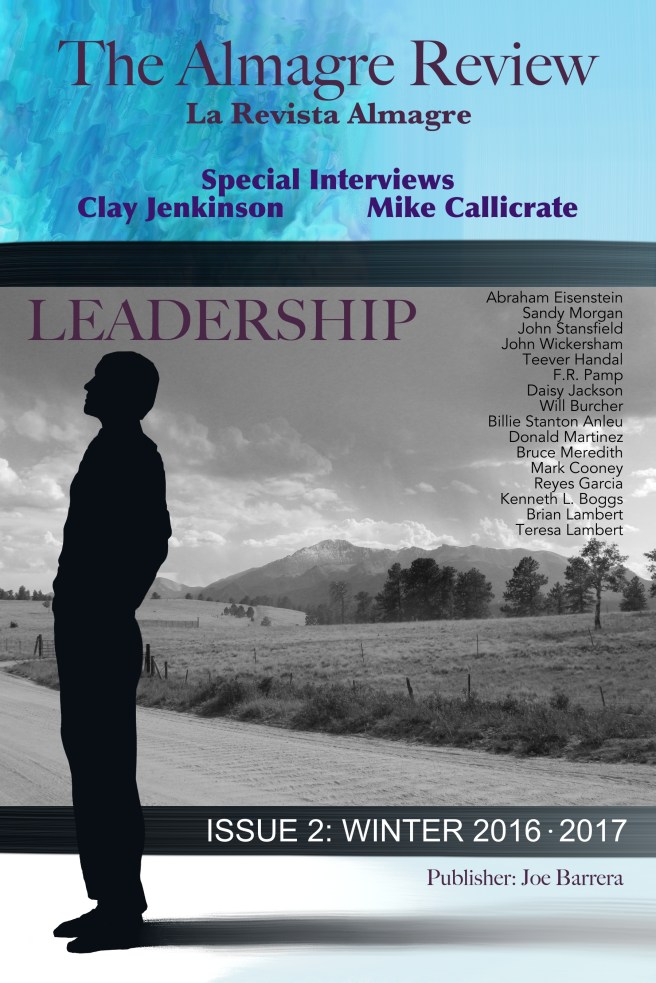
Issue 2: “Leadership” has Arrived!

It’s official, announcing the arrival of Issue Two.

leadership-cover-2jpeg

The Almagre Review/La Revista Almagre is excited to share the publication of our second issue. We have wonderful local contributors, writers from up and down the front range, from the prairie, all the way to Wisconsin. To purchase a copy online, click HERE ($12 plus shipping). Copies are also available at the downtown locations of Hooked On Books and Poor Richards.

The Almagre Review will be at the Manitou Art Center on December 16th for their art opening. Copies of issues one and two will be available for purchase. Stay tuned for additional dates and events.

Warm Regards,

The Almagre Staff

Contemporary Heroes; Hooked On Books

Yes, in the spirit of leadership, the theme of issue two, we’d like to honor bookstores and especially their proprietors.

The Almagre Review wants to take a minute to thank Hooked On Books for their enduring dedication to Colorado Springs’s local authors. One might not realize this, but Jim and Mary Ciletti devote a tremendous amount of time and resource to writers who publish and sell their work locally.

The bookstore, we all know, is a diminished institution. This is not because we read less than we used to; that is a misconception. We read more than ever. But, we read differently. Deep attention to long, rich works grows scarcer by the year. We collect information like grains of sand blowing through the air. News by captions! This is the age of trying to form complex world-views out of a chaotic constellation of information. Our contemporary consumption of the written word has conferred all its disadvantages upon the local bookstore.

Companies like Barnes and Noble can manage, but even then, not all the large companies survive–Borders went out of business. And for the mom and pops bookstore? To find one is a treasure, to support them–a public service. There’s a touch of the heroic, born of faithful dedication, to Jim and Mary Ciletti for their labors in sustaining a brick and mortar location for story enthusiasts like us.

As a gesture of friendship, take the time to stop by Hooked On Books, or any bookstore. The Almagre recommends this from a place of deep gratitude. While there, let Mary or Jim know, that it was at the urging of Colorado’s newest literary journal. Most importantly, ask the proprietor, “what book by a local author do you suggest today?”

bookstore-graphic